
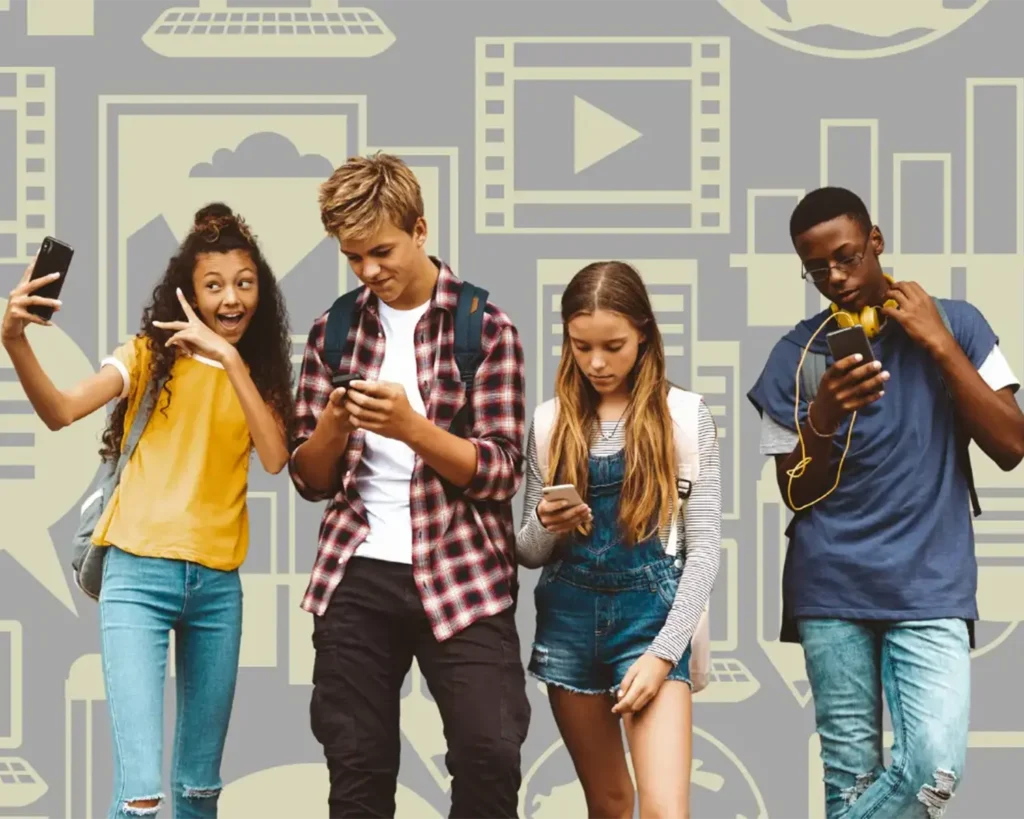
From Clickbait to Clarity: Teaching Kids to Think Critically About Media
23 August, 2025

Author Dr Will Zoppellini
“Did you hear they found a new planet in our solar system where it rains diamonds?”
The teens eyes are wide, their voice bursting with certainty. They read it online just this morning, it was a colourful image, a catchy headline, and thousands of shares. It’s fascinating, surprising, and… maybe too good to be true.
In that moment, we pause, maybe not to tell them whether it’s true or false, but to ask, “How do you know?”
This is a vital challenge in education today, the space between seeing a claim and deciding whether to believe it. Our children, from primary education all the way to university, navigate an information-saturated world where truth and fiction often share the same stage. They can stumble across viral “facts” like diamond rainfall on distant planets, miracle health cures, and deepfake videos, all in the same five-minute scroll.
Media literacy is a core survival skill for modern life. In a time when misinformation can travel faster than truth, the ability to pause, question, verify, and consider alternative perspectives is as vital as reading or arithmetic.
Over the years, I’ve seen that teaching media literacy isn’t about making young people cynical. It’s about making them capable and giving them the tools to see beyond the headline, to test the claim, and to understand the forces shaping the messages they are exposed to.
Table of Contents
In this post, I’ll examine how critical thinking is the foundation of media literacy, which skills matter most, and how we can embed them in everyday learning in any situation, at any age. Because if the next generation is going to navigate the diamond rains or flat earth of the digital world, they’ll need more than curiosity.
Pour yourself a fresh cup, get comfortable, and let’s filter through the noise together.
What is Media Literacy & Why It Matters
Children have almost limitless access to information1, often without adult involvement, and the boundary between credible sources and fabricated content can be razor thin. This isn’t about unsupervised phone use, and it isn’t limited to social media. Information surrounds children constantly all the time. Discernment is important for false “facts” like “Scientists Confirm Chocolate Milk Comes from Brown Cows,” or more dangerous headlines like “Drinking Salt Water for a Week Can Cure All Diseases, Researchers Say.” Both can be presented with convincing images and confident-sounding language, making them surprisingly easy for children to believe2.
Media literacy is the ability to access the media, to understand and critically evaluate different aspects of the media and media contexts, and to create communications in a variety of contexts.

A lack of media literacy can weaken learning across subjects, as students struggle to recognise trustworthy sources. At the more extreme end, it can leave them vulnerable to false health claims, climate change denial, and fabricated “science” that doesn’t just mislead, but can cause real harm. Persuasive design, targeted advertising, and emotionally charged narratives can deepen divisions, erode trust in credible institutions, and influence decisions that affect both personal wellbeing and public safety.
One of the founders of critical thinking, John Dewey3, argued that for a democracy to function, citizens must be able to evaluate claims, weigh consequences, and make decisions that go beyond instinct or ideology. In today’s digital landscape, where a manipulated image can sway public opinion in minutes, his words feel more urgent than ever.
A study by a group of researchers from MIT4 found that false news spreads significantly faster and reaches more people than true news on social media. They explained that this is often because it triggers stronger emotional reactions. This means children are more likely to encounter misinformation first, before they see a reliable correction, if ever. Layer on top the algorithms that curate content based on past clicks and views, and you have the perfect conditions for echo chambers to form, reinforcing what they already believe rather than challenging them to think critically.
The Connection Between Critical Thinking & Media Literacy
The relationship between critical thinking and media literacy works both ways. Strong media literacy strengthens critical thinking by exposing learners to a wide range of sources and perspectives5. Likewise, strong critical thinking skills deepen media literacy by enabling students to spot bias, identify misinformation, and evaluate the credibility of what they see.
Media literacy isn’t a new skill, but in today’s digital environment, it’s become an essential tool. We should try and educate children to apply critical thinking skills to everything they read, watch, and share. It’s the difference between passively consuming information and actively questioning it.
The skills needed to navigate media are much the same, as those I’ve discussed previously on building critical thinking:
- Evaluating evidence for credibility and relevance.
- Considering multiple perspectives and recognising bias.
- Asking whether a claim is supported by reliable proof, or if it’s simply designed to persuade.
An important part of teaching media literacy is helping children distinguish between misinformation, disinformation, and malinformation. Understanding these distinctions helps them see that not all “wrong” information is created for the same reason, and that intent matters when assessing a source.
Key Terms Explained
- Misinformation:
- Disinformation:
- Malinformation:
Approaching Media Literacy from 4 to 16
It’s important to recognise that we can start early and develop critical thinking and media literacy skills as children grow6. Each stage should include developmentally appropriate approaches that should evolve with maturity.
Ages 4–7: Building Foundational Thinking Skills
Children as young as four can begin to differentiate between reality and fiction and can assess the credibility of information. A study1 explored how 4–7-year-olds decide whether a claim is true, and the researchers found that children were more likely to check facts, and become better at spotting false information, if they had previously been exposed to obvious inaccuracies.
Interestingly, this means that “sanitising” what children hear, like giving them only accurate information, might unintentionally reduce their natural thinking skills1. In fact, the study suggests that carefully exposing children to harmless falsehoods could help them develop critical thinking skills1,6.
Ages 7–11: Strengthening Source Awareness and Context Cues
Ages 11–16: Building Independent Evaluators

Key Skills & Strategies for Developing Media Literacy
Studies on media literacy pedagogy for children and adolescents emphasise the importance of collaborative, creative, playful, and multimodal media production practices9,10, as well as analytic, reflective, inquiry-, and project-based learning11,12
Cross-curricular work is also a powerful tool. When multiple teachers work with students on the same topic or phenomenon, the depth of understanding multiplies9,13. For example, a unit on climate change could see science classes exploring the data, English lessons examining persuasive techniques in media articles, and art lessons creating infographics to communicate findings. This reinforces skills across contexts and shows students that critical thinking applies everywhere, not just in one subject.
*See my blog post on Teaching Critical Thinking.
Here are the key skills every child should be developing:
Source checking – Who wrote this? What’s their purpose?
Evidence evaluation – What proof is offered? Is it credible and reliable?
Bias spotting – How is language, imagery, or tone used to persuade?
Cross-checking – Compare the claim with multiple reliable sources.
Algorithm awareness – Why might this post, video, or ad have been shown to you?
Media literacy grows strongest when it’s woven into everyday interactions, such as at the dinner table, while travelling, in the classroom, or during training. These strategies use real-world examples to make the skills relevant, memorable, and transferable.
1. Analyse real examples together
2. Play “Two Truths and a Lie: News Edition”
3. Create a “Fact-Check Wall”
4. Debate respectfully
5. Model your thinking out loud
Whether you’re a teacher, coach, or parent, narrate your own process of evaluating a claim:
- “This sounds impressive, but where’s the data?”
- “I wonder what this group gains if we believe this?”
- “I’ll check two other sources before I decide.”
Children absorb more from what we do than from what we say; when they see us pause, question, and verify, they’re more likely to mirror those habits.
6. Link skills to their interests
If a teenager follows a sports influencer, analyse their content together. If a younger child loves nature, look at viral animal videos and discuss whether they’re real. By meeting them where their passions are, you make critical analysis personal and engaging.
When approached with collaboration and creativity, these skills become habits of mind. Over time, children learn not only to detect falsehoods but also to appreciate the complexities of truth6. They start to see media not as something fixed, but as something constructed, and therefore something they have the power to question, reshape, and use responsibly.
Final thoughts

Developing media literacy isn’t about making children cynical, but about giving them the confidence and skills to navigate an overwhelming flow of information. In a world where false stories often travel faster than true ones, we can’t assume children will naturally learn to question what they see. By supporting them to evaluate sources, recognise bias, and check evidence, we equip them to become active and informed thinkers.
Media literacy, grounded in critical thinking, gives young people the tools to cut through the noise, challenge misinformation, and make decisions based on truth rather than persuasion. In doing so, we prepare them not only to understand the world, but to change it.
Until next time, stay curious
Dr Will Zoppellini
Another cup of theory? Discover more...



Educating Minds to Question: Understanding and Teaching Critical Thinking

References
- Orticio, E., Meyer, M. and Kidd, C., 2024. Exposure to detectable inaccuracies makes children more diligent fact-checkers of novel claims.Nature Human Behaviour, 8(12), pp.2322-2329.
- Potter, W.J., 2018.Media literacy. Sage publications.
- Dewey, J. 1910 How We Think, D. C Heath & Co Publishers: Chicago
- Vosoughi, S., Roy, D. and Aral, S., 2018. The spread of true and false news online.science, 359(6380), pp.1146-1151.
- D & Dunn. D. 2022. Thought and Knowledge: An Introduction to Critical Thinking. Routledge
- Share, J. 2015. Media Literacy is Elementary: Teaching Youth to Critically Read and Create Media (2nd Edition). Peter Lang.
- Lopez-Mobilia, G. and Woolley, J. D. 2016 ‘Interactions Between Knowledge and Testimony in Children’s Reality-Status Judgments’,Journal of Cognition and Development, 17(3), pp. 486–504.
- Sperry, C. and Scheibe, C. 2022.Teaching students to decode the world: Media literacy and critical thinking across the curriculum. ASCD.