
Rewriting the Curriculum: How to Teach Thinking in Every Lesson
15 August, 2025

Author Dr Will Zoppellini
When I taught at university, I had a class for final-year students on pedagogy. I often told the students that the goal of education shouldn’t be to help children simply solve questions, but to help them question the question itself. I illustrated this through the following hypothetical scenario with school children:
“Imagine you’ve got a building,” I’d explain to the school children, “and outside it sits a container of water. The water is usually delivered into the building via a tap. But the tap’s broken, and you don’t know why.”
Then I’d ask: “So… how do you fix the tap to get the water flowing again?”
Some students jumped straight into technical solutions, ready to tinker with valves and pipes. But after a pause, a few began to frown, then smile. One finally raised her hand and said: “I think you’ve asked the wrong question.”
I asked her “why”, She replies “We don’t know that fixing the tap is the best solution… Maybe we should be thinking about how we get water back into the building in the most effective way?” – Exactly!!
Table of Contents
It wasn’t about fixing the current system, but about finding how best to solve the delivery of the water. Maybe the old method could be repaired. Maybe it needed replacing entirely. But until they challenged the question itself, they risked solving the wrong problem.
The best thinkers don’t just search for answers, they challenge the premise, reframe the problem, and decide whether they’re even solving the right thing.
That’s the kind of thinking I hope we cultivate. Not just better answers, but better questions.
Some of the university students were energised, vowing to bring this kind of thinking into their own classrooms. Others were sceptical. “Would this even be possible in schools today?” they asked, not as an occasional enrichment exercise, but as a core, assessed part of learning. My answer then, is the same as now… “I’m not sure yet… but I’m hopeful.”
Hopeful, because this way of thinking, this ability to question, examine, reason, and reframe problems, is what we need for our next generation of scientists, artists, business owners, and citizens.
In this post, I’ll explore how we can approach teaching critical thinking. How it can be developed at any age, the frameworks that guide it, and some practical ways to weave it into everyday learning. This isn’t about adding more to the workload, it’s about reimagining how we teach what we already teach.
Integrating Skills and Content in Critical Thinking Education
Educators developing critical thinking give children greater understanding & autonomy over their own learning1. Research has consistently linked strong critical thinking abilities to higher academic achievement, sharper problem-solving and decision-making, deeper ethical reasoning, and a stronger capacity for democratic participation2.
The challenge is that critical thinking doesn’t emerge automatically because students are exposed to information3. The way we teach it matters, and this can be very challenging.

Research identifies two main approaches, The first is to integrate critical thinking directly into existing subjects1. In this model, skills such as reasoning, evaluating evidence, and making judgments are taught through the content knowledge4. Students learn to think like historians in history, like scientists in science, and so on. The second approach treats critical thinking as a standalone subject5, isolating skills such as identifying bias, weighing perspectives, or analysing evidence, with the goal of transferring them into other contexts.
In reality, most education systems have a crowded curriculum already. Adding a full, separate course on critical thinking is often either unrealistic, or a burden to staff. That’s why for many educators, especially those new to teaching critical thinking, embedding these skills into existing subjects is a strong starting point. Content knowledge becomes a springboard, helping students gain the confidence to ask deeper questions and explore multiple solutions. There is always the option to introduce a blended approach where some of the skills are isolated and taught separately later.
Mentoring and dialogue are essential for critical thinking to flourish in education, especially when discussion can be guided2,6. When teachers mentor students through the thinking process, model how to question respectfully, and give feedback that challenges assumptions, they build a culture where inquiry feels safe and expected. Structured dialogue, whether through debates, peer questioning, or collaborative problem-solving, gives students the chance to practice reasoning, learning to articulate their ideas while listening carefully to others1.
Teaching critical thinking isn’t about choosing one method over another, but rather creating learning environments where thinking is valued. Ensure there is always attention given to assessing thinking, analysing thinking, and improving thinking.
Practical Strategies & Frameworks For Critical Thinking
There are many research-backed strategies that help foster critical thinking. While there is no single formula, these strategies consistently stand out as both practical and adaptable – navigate through the dropdown menu to learn more.
1. The Paul-Elder Critical Thinking Framework
The Paul–Elder model is one of the most widely used frameworks in education, particularly at secondary and higher education. It breaks critical thinking into three interconnected parts2,7.
Elements of Thought:
Intellectual Standards:
Intellectual Traits:
The habits of mind developed through consistent application of the elements and standards. These include intellectual humility, empathy, integrity, perseverance, and confidence in reason. These traits are not add-ons; they are essential qualities for learners who will navigate complex social, ethical, and professional challenges. By cultivating these traits, we help students not only think well but also act with thoughtfulness and integrity.
What makes this framework especially powerful is its transferability. Whether students are writing an essay, discussing a novel, solving a math problem, or exploring ethical dilemmas, the Paul–Elder model gives them a common language and structure to examine their thinking.
2. Use Real-World Problems
When students engage in issues they care about, their thinking becomes more purposeful1. Projects tied to climate change, inequality, or local community problems create natural opportunities to evaluate sources, consider multiple perspectives, and propose evidence-based solutions. You can also find subject specific issues to use.
Teachers might consider building interdisciplinary projects that merge science, citizenship, and writing, art, or physical activity. for example, designing an action plan to reduce waste in their school. These projects not only foster deep learning but promote agency and ethical decision-making.
3. Model Your Thinking Out Loud
One of the most overlooked strategies is also one of the simplest. Whether you’re a parent, teacher, or coach, narrating your thought process helps children see what good thinking looks like.
- "I wonder if that stat is reliable... who published it?"
- "I'm not sure that's fair. Let me think it through before I decide."
- "That article made a strong claim. I’ll check another source."
Children learn more from what we model than what we instruct. They begin to emulate the internal questions we demonstrate.
When we put structured frameworks, real-world engagement, and visible modelling together, they create a learning environment that cultivates and reinforces critical thinking.
Age-Appropriate Thinking Skills
Critical thinking just looks different at different ages, but you can start teaching at any time. From a developmental psychology perspective, some theories suggest that younger children lack the abstract reasoning needed for certain critical thinking tasks2. Yet, research shows surprisingly little difference in critical thinking performance across age groups using age-appropriate assessments1. This might be because standardised tests don’t capture the subtleties of how younger children think, or perhaps it’s because they are more capable than we’ve assumed.
The strategies simply need to match the child’s developmental stage, interests, and lived experiences.
Ages 4–7
Young children are natural questioners. Build on that!
- Use “why” and “what do you think” questions.
- Read picture books that involve characters making decisions.
- Encourage sorting, categorising, and explaining choices.
Ages 8-12
This age group is ready to start identifying cause and effect, comparing sources, and recognising bias.
- Introduce the idea of “evidence” to support opinions.
- Use games and stories that require evaluating different viewpoints.
- Encourage children to consider alternatives before solving a problem.
Ages 13–16
Teens are ready to tackle complex arguments and multiple perspectives.
- Use current events to practise evaluating credibility.
- Have students develop and defend a position, using real sources.
- Discuss how beliefs form and change.
A Classroom Example: Critical Thinking in Action
Secondary Science & The Mystery of the Dying Fish: In a secondary education biology lesson, students are presented with a short scenario:
“A local lake has recently experienced a sudden drop in fish numbers. Your job is to investigate why.”
Rather than giving them a worksheet with pre-set questions, the teacher encourages students to frame their own inquiry. Using the Paul–Elder Elements of Reasoning, she guides them to think about:
Purpose: “What are we trying to find out?”
Question at issue: “What exactly is our central question?”
Information: “What data do we need before making any conclusions?”
Assumptions: “Are we assuming the fish died from one cause?”
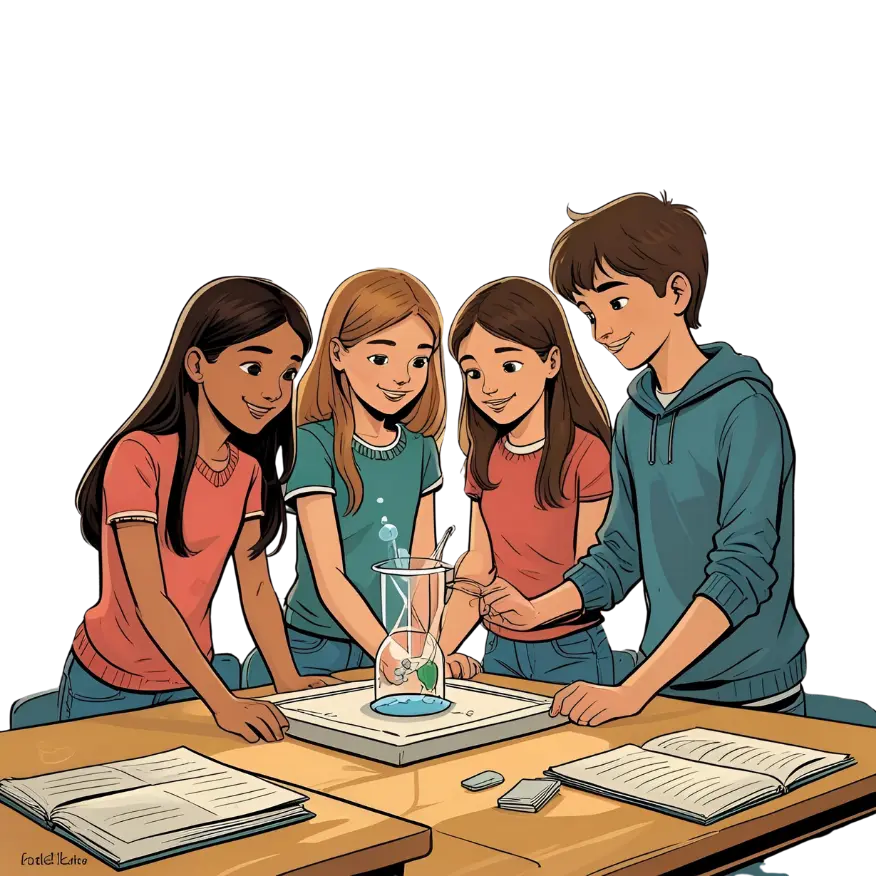
Students collaborate to suggest possible causes (pollution, invasive species, changes in water temperature, disease) and decide what evidence would confirm or challenge each one. They design small-scale investigations such as checking pH and oxygen levels, examining water samples for pollutants, researching weather patterns, and reviewing local news for industrial activity near the lake.
The teacher circulates, modelling Intellectual Standards:
- “Is that explanation precise enough, or could it be more specific?”
- “Have you considered an alternative explanation?”
- “How reliable is the source you’re using for your data?”
As groups report back, they’re encouraged to challenge each other respectfully, identify gaps in their reasoning, and refine their conclusions. By the end, they’ve learned that there is rarely one simple answer in science, problems can be complex, evidence can be partial, and multiple perspectives need to be considered before making claims.
What began as a mystery about fish became a lesson in questioning assumptions, evaluating data quality, and building reasoned arguments.
Final thoughts

Teaching critical thinking isn’t about adding more to an already overcrowded curriculum but transforming how we approach what’s already there. It means shifting the focus from memorising answers to interrogating questions, from absorbing information to actively testing it.
The future generations will face some of the greatest challenges in human history. These include climate change, technological disruption, social inequality, global instability, and many more. We owe it to them to equip them with the tools to meet those challenges head-on, and analyse problems deeply, collaborate across differences, and create solutions none of us could imagine alone.
Until next time, stay curious
Dr Will Zoppellini
Another cup of theory? Discover more...



Educating Minds to Question: Understanding and Teaching Critical Thinking
References
- Abrami, P.C., Bernard, R.M., Borokhovski, E., Waddington, D.I., Wade, C.A. and Persson, T. 2015. Strategies for teaching students to think critically: A meta-analysis.Review of educational research, 85(2), pp.275-314.
- Woolfolk, A. (2019). Educational psychology (14th).New York: Pearson.
- Abrami, P.C., Bernard, R.M., Borokhovski, E., Wade, A., Surkes, M.A., Tamim, R. and Zhang, D. 2008. Instructional interventions affecting critical thinking skills and dispositions: A stage 1 meta-analysis.Review of educational research, 78(4), pp.1102-1134.
- McPeck, J. 1981. Critical thinking and education. Toronto, Ontario, Canada: Oxford University Press.
- Siegel, H. 1988. Educating reason: Rationality, critical thinking, and education. New York, NY: Routledge.
- Kuhn, D., 1999. A developmental model of critical thinking.Educational researcher, 28(2), pp.16-46.
- Elder, L. and Paul, R. 2020.Critical thinking: Tools for taking charge of your learning and your life. Rowman & Littlefield.
- Elder, L. and Paul, R. 2008. The Miniature Guide to Critical Thinking: Concepts and tools. Foundation for Critical Thinking Press.