

The power of Praise in creating resilient learners
18 July, 2025

Author Dr Will Zoppellini
Regardless of the role you have in supporting learning, you’ve probably heard the following phrases a thousand times:
A coach pats a teen football player on the back after a game. “You’re a natural goal scorer,” he said, grinning, hoping to lift her confidence after a tough match.
In a busy classroom children are being given their math tests back, a teacher looks at a student. “You’re a genius!” she declared, beaming at the boy who’d aced it, eager to make him proud.
Meanwhile, at the coffee table in their living room, a parent watched their child finish a pencil sketch drawing. “You’re so gifted” they whispered warmly, wanting to motivate their budding artist to keep drawing.
What do all these phrases have in common… none of them help foster learning. These words feel encouraging in the moment. We mean well. But too often, they plant the idea that success depends on being naturally gifted.
Table of Contents
When things get hard, children may stop trying, afraid that failure reveals they aren’t truly talented. Feedback is never just words. It’s a message about how learning works. It can invite children to see challenges as threats to avoid, or as opportunities to grow. It can inspire to continue or prompt a child to stop.
In this post, I’ll explain how a whole area of research led us to thinking this type of praise was good for children. I’ll highlight key studies that show the incredible results possible when we change the way we praise, and I’ll share a story that will make you reflect on the messages you give to a child.
Coffee ready, settled in, and let’s take a relaxed look at what the science tells us.
How Early Research Led Us to Unintended Consequences
Decades ago, the self-esteem research movement led many teachers and parents to believe that praising children for their abilities would boost confidence and achievement. This was a classic example of adopting research too soon, before enough evidence was gathered.
Comments like “You’re a genius!”, or “You’re naturally talented!” became the norm. Early studies on small groups suggested short-term benefits in how kids felt about themselves, so this approach spread widely in schools and homes.
But these good intentions had unintended consequences. Focusing praise on innate talent promoted a fixed mindset, making children see ability as something you either have or don’t. When more rigorous, long-term research arrived, it showed this strategy often backfired, leading to less motivation, fear of failure, and avoidance of challenges. But by then, the damage was done, the perception that this type of praise was positive wash out in the world.
Inside One Experiment Revealing the Power of Praise
To highlight the profound effect different types of praise can have on resilience and achievement, let’s examine a landmark study by psychologists Claudia Mueller and Carol Dweck2.
What They Did

One group received person praise (e.g., “You’re so smart”), praising innate ability. The outcome isn’t separated from the person.
Next, all the children were given a choice to take a test at the same level, or to take a more challenging one. Most process-praised children chose the harder test, seeking challenge. Most person-praised children chose the easier test, staying in their comfort zone. This pattern held across variations in the studies.
At the end, all children took a test equal in difficulty to the first one. Strikingly, some in the process-praise group improved their scores by up to 30%, while some in the person-praise group dropped by as much as 20%. In some cases, this was up to a 50% difference driven by how they were praised over a short period (less than a school year).
Other Key Findings
*Expand each section below to learn more about the key findings
Person Praise Encouraged Performance Goals
Children praised for innate ability (You’re so smart) focused on proving it rather than improving. They become cautious, avoiding challenges that might expose failure, or cause them to not look smart in front of significant figures like a parent or teacher.
Process Praise Fostered Learning Goals
Better Response to Failure
Person-praised children were less likely to persist after failure. They gave up quicker, felt worse after setbacks, and even hid failures from peers to protect their “smart” image. Process-praised children showed greater persistence, enjoyment, and a positive attitude toward learning from mistakes.
Long-Term Mindset Effects
Over time, person praise encourages a fixed mindset, believing ability is innate and unchangeable. Process praise fosters a growth mindset, believing ability can be developed through effort and learning.
Other studies4,5,6 in different contexts and with different ages, have gone on to confirm the findings that process focused praise, and feedback creates more resilient learners. Kamins & Dweck 3 even found that when 5–6-year-olds received process praise, they showed more resilience and motivation than those praised for their traits.
Practical steps you can take
Help children focus on how they are learning and what strategies they are using. Feedback should encourage students to see challenges as opportunities, mistakes as learning moments, and effort as the path to growth 6, 9.
- Process praise builds resilience: Highlight effort, strategies, and progress.
- Avoid person praise: While it is good to praise achievements. Labelling students as naturally “smart” or “talented” can make them risk-averse and fear failure.
Person Praise
Process Praise
You’re a natural at solving math problems
A short story on building perseverance & resilience

Ruby was ten, and loved to throw herself into any sport she could. She enjoyed the focus of swimming and the freedom of sprinting around the basketball court. But when she discovered dancing, it felt different, magical, a way to show the world who she was inside.
After just a few weeks of lessons, picking up new steps and conquering a challenging routine, Ruby was excited to try her first solo dance competition. When the big day arrived, she poured her energy into her performance, moving with grace. The judges seemed impressed, and her first scores looked promising. Stepping off the stage, she was radiant, her face lit up from the cheers and applause.

But as more dancers performed, the rankings shifted. By the end, Ruby hadn’t placed at all. The glow she felt melted into a heavy, aching disappointment when she realised she wouldn’t be taking home a medal or trophy.
In the car on the way home, the emotions she’d tried to hold back came flooding out. Tears streamed down her cheeks as she sobbed to her father, her voice cracking, “I’m never doing dance again. I’m just not good enough!”
Feedback Options
Here are the five most common messages we send to children. I haven’t written them in the exact phrasing you might say, just what the core message is. What feedback would you give Ruby?
Option 1: Comfort her and tell her that you thought she was the best one there.
Option 2: Tell her that the judges were unfair and that she was robbed of the prize.
Option 3: Explain that she shouldn’t worry because dance isn’t that important anyway.
Option 4: Tell her she is talented and with her ability she will win for sure next time.
Option 5: Explain to her that she didn’t deserve to win this time.
It’s important to reflect on how we guide children through challenges, not just in the moment, but for their future learning and resilience. Unfortunately, messages in our society & in our education systems often encourage us to protect children from failure at all costs, hoping to boost their self-esteem. While this approach might soothe temporary disappointment, it can have long-term negative effects, hindering resilience and their ability to learn from setbacks independently.
Let’s take a closer look at what each choice really communicates
Option 1: Comfort her and tell her that you thought she was the best one there.
This feedback, while comforting in the moment, is insincere. Ruby knows she wasn’t the best, it’s clear from the competition results. Hearing this doesn’t help her recover or improve. Without constructive feedback, she’s left without a path to grow or understand what to do differently next time.
Option 2: Tell her that the judges were unfair and that she was robbed of the prize.
Blaming the judges for the outcome deflects responsibility from Ruby’s performance and encourages her to externalize blame. While this may temporarily alleviate her disappointment, it doesn’t teach her to reflect on her own efforts and identify areas for improvement. Over time, this mindset can foster a habit of blaming others for setbacks instead of focusing on personal growth.
Option 3: Explain that she shouldn’t worry because dance isn’t that important anyway.
This response dismisses Ruby’s feelings and teaches her to devalue activities when she doesn’t excel right away. While it might seem like a way to shield her from pain, it teaches her to devalue pursuits she isn’t immediately successful in. This approach limits her ability to develop resilience and perseverance.
Option 4: Tell her she is talented and with her ability she will win for sure next time.
While this may sound supportive, it sends a dangerous message. Talent alone doesn’t guarantee success. Without addressing areas for improvement, Ruby is left with false hope rather than actionable advice. If she didn’t win this time, why would she win the next?
Option 5: Explain to her that she didn’t deserve to win this time.
Though this might seem harsh, the truth can be the most helpful message if delivered with care and empathy. By acknowledging that Ruby didn’t earn the win this time, we give her the opportunity to reflect on what she can do differently next time. While it might sting initially, this feedback can foster resilience, learning, and a clearer path to improvement. Based on all the research this is the response grounded in growth mindset.
What Ruby’s Father Said (How we can deliver the message)

Ruby’s father chose a growth-minded approach, to explain to her that she didn’t deserve to win this time. Here’s what he said:
“Ruby, I know how you feel. It’s so disappointing to have your hopes up and perform your best but not to win. But you know, you haven’t really earned it yet. There were many girls there who’ve been dancing and training longer than you and who’ve worked a lot harder than you. If this is something you really want, then it’s something you’ll really have to work for, and improve in the areas you didn’t do well in.”
He also reassured Ruby that if she wanted to pursue dance purely for fun, that was perfectly fine. But if she wanted to excel in competitions, more effort and technical practice would be required. He promised to help her find the right support and strategies to improve.
The Power of Honest, Growth-Oriented Feedback

Ruby listened carefully to her father’s words, even though they stung at first. But something in them lit a spark. She began devoting extra time to her routines, determined to fix the parts she knew were weakest. Her father was there every step of the way, helping her juggle her other activities while supporting her growing passion for dance.
At each new competition, her scores edged higher. After a few more events, she finally heard her name called for an individual award, then a first-place finish. Now, her room is overflowing with dance shoes, costumes, and trophies, a compliment to all the hours she’s poured into mastering her craft. She loves every moment she spends working to get even better.
Teaching Resilience and Growth
Ruby’s father didn’t gloss over the truth or hide the sting of disappointment. He listened, empathised, but refused to offer false praise or unrealistic promises. Instead, he showed her how to face what went wrong, learn from it, and put in the work to succeed.
This approach not only helped Ruby achieve her goals but also equipped her with the resilience and learning strategies she’ll need for future challenges.
Final thoughts

If we really want to help children succeed, let’s prepare them for challenges and build their mindsets for learning. Choosing honest, constructive feedback focused on the process, over empty comfort means we can help children become resilient 9,10.
Until next time, stay curious.
Dr Will Zoppellini
Another cup of theory? Discover more...

how to grow your brain: what neuroscience tells us about learning, mistakes, and motivation

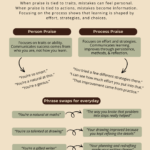
Download the practical strategies from this post as a free printable infographic
*By signing up, you agree to receive emails from Coffee & Theory. You can unsubscribe at any time.

References
References
- DWECK, C. S. 2008. Achievement in Math and Science. Journal of Educational Psychology, 96(1), 97-109
- MUELLER, C.M., and DWECK, C.S. 1998. Intelligence praise can undermine motivation and performance. Journal of Personality and Social Psychology, 75, 33-52.
- KAMINS, M., and DWECK, C. S. 1999. Person vs. process praise and criticism: Implications for contingent self-worth and coping. Developmental Psychology, 35, 835- 847.
- CORPUS, J. H., and LEPPER, M. R. 2007. The effects of person versus performance praise on children’s motivation: Gender and age as moderating factors. Educational Psychology, 27, 1– 22.
- CIMPIAN, A., ARCE, H., MARKMAN, E. M., and DWECK, C. S. 2007. Subtle linguistic cues impact children’s motivation. Psychological Science, 18, 314–316
- HAIMOVITZ, K., and CORPUS, J. H.2011. Effects of person versus process praise on student motivation: Stability and change in emerging adulthood. Educational Psychology, 31, 595–609.
- HAIMOVITZ, K., and DWECK. C. S. 2017. The Origins of Children’s Growth and Fixed Mindsets: New Research and a New Proposal. Child Development, 88(6), 1849-1859
- JONSSON, A.C., and BEACH, D. 2012. Predicting the Use of Praise among Pre-Service Teachers: The Influence of Implicit Theories of Intelligence, Social Comparison and Stereotype Acceptance. Education Inquiry, 3, 259-281.
- RISSANEN, I., LAINE, S., PUUSEPP, I., KUUSISTO, E., and TIRRI, K. 2021. Implementing and Evaluating Growth Mindset Pedagogy–A Study of Finnish Elementary School Teachers. In Frontiers in education. p. 385.
- ZEEB, H., OSTERTAG, J., and RENKL, A. 2020. Towards a growth mindset culture in the classroom: Implementation of a lesson-integrated mindset training. Education Research International.