
Why Play Has No Age Limit: Rethinking Learning Beyond Early Childhood
19 September, 2025

Author Dr Will Zoppellini
Is there a time when play should no longer belong in learning?
In education we imagine a dividing line. On one side, toddlers pretending to be pirates, sketching dragons, and building elaborate constructions. On the other side, solemn adolescents hunched over laptops, memorising formulas, and filling in individual exam papers. But that line is an illusion put there by adults. The truth is that play doesn’t vanish with age but instead transforms into new expressions of curiosity and creativity.
But somewhere along the way, our education systems decided that play belongs only in nursery and the early years. In most systems, it isn’t phased out gently but stripped away almost overnight the moment children step into primary education. The further children move through the system, the more play is perceived as an enrichment at best, and a waste of time at worst. In its place comes rigid instruction, crowded curricula, and narrow measures of success. Sending the message that joy, and imagination are luxuries, while “real” learning must always be serious, sober, and testable.
Research in learning, neuroscience, and psychology tell us the opposite. From toddlers to teenagers to adults, playful learning unlocks curiosity, builds resilience, and strengthens the brain’s networks for memory, focus, and problem-solving1,2. Play nurtures the very twenty-first-century skills that “serious”, exam-based education often claims to prepare children for but rarely delivers, including critical thinking, collaboration and emotional intelligence3.
Table of Contents
I want to ask you, what if there was never a time for play to end, only new ways for it to evolve?
In this blog, I’ll explore why play has no age limit. I’ll show how older children and teenagers benefit from playful learning, why it matters for their wellbeing, and how active, meaningful, and engaging approaches can transform classrooms. Finally, I’ll share practical ways to reintroduce play into education well beyond the early years.
So, pour yourself a coffee and let’s reimagine why play should never be left behind.
Why Play Matters for all children
By the time children reach upper primary or secondary education, many adults assume play-based learning has served its purpose. Now it’s time for “serious” work. Yet teenagers exist in a liminal space, between childhood and adulthood, where play may be as vital as ever.
Play can help adolescents manage anxiety and stress, offering a natural release valve in years often defined by social pressure and academic expectation4. Evidence from neuroscience reveals that joyful engagement increases dopamine levels, priming the brain to learn and reinforcing neural connections that support memory and motivation5,2. Play even strengthens the very neural circuits students rely on when tackling exams or navigating social complexity.
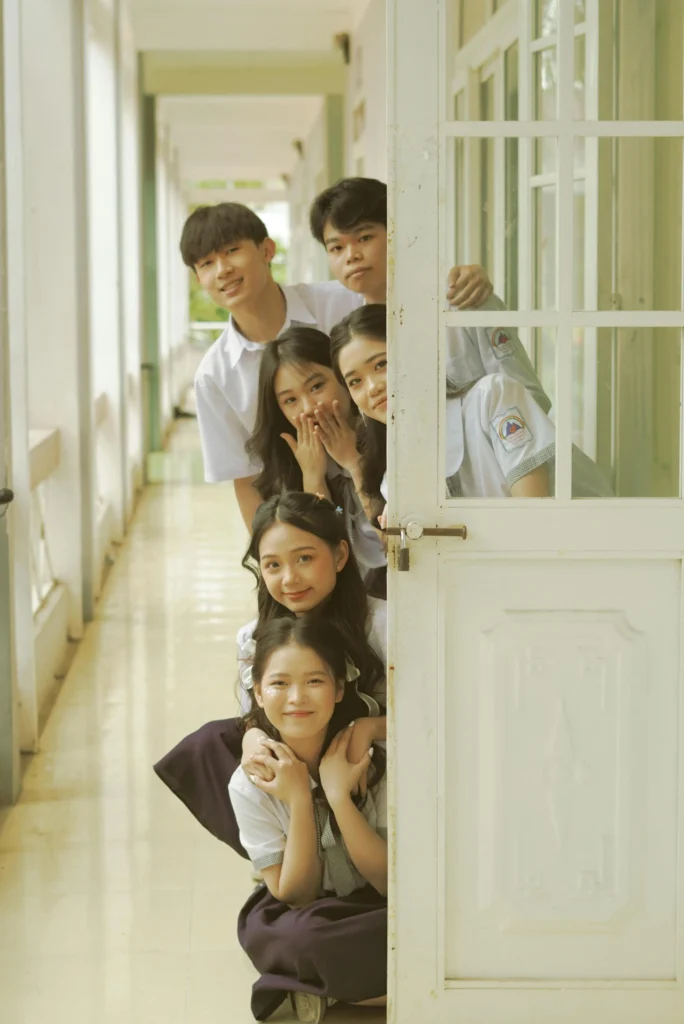
By its very nature, play is a trial-and-error process, demanding persistence in the face of obstacles. These conditions give students agency, spark curiosity, and immerse them in learning. All qualities essential for deeper understanding and wellbeing6. Evidence also suggests that active participation in playful knowledge creation can improve academic outcomes. One study7 that explored integrated playful approaches with older students, found that the teachers reported better organisation, communication, and decision-making skills in the students. Just as important, the study found that play reshaped how students viewed school itself. When learning felt playful, adolescents were more engaged, less anxious, and more willing to persevere through challenges.
Despite evidence from both from researchers and educators, play is still rarely embraced as a pedagogical tool beyond the early years4. The result is a troubling gap, the years when students perhaps most need creative, collaborative, and stress-reducing experiences are the years when play is most absent8.
When teenagers are given playful opportunities, whether through simulations in science, improvisation in drama, or project-based collaboration, they experience learning as something meaningful and motivating. In a world where student disengagement and stress are climbing, we cannot afford to dismiss the tools that make learning attractive.
Play as Active, Meaningful, and Engaging Learning
Play offers education a recipe for genuine engagement. Researchers describe three channels that make this possible: active, meaningful, and engaging learning8. Together, they transform how children think, feel, and connect with knowledge.
Active learning
means “minds-on.” It’s not about students sitting still, receiving information, but exploring, questioning, and experimenting. Decades of research, from theorists like Piaget to modern cognitive science, have shown that children and adults alike learn better when they participate actively rather than passively9,10.
Meaningful learning
connects new ideas to what students already know and care about8. A study in children’s museums found that when adults asked elaborative questions like, “Where do you think this comes from?” or “What does that remind you of?”, children engaged more deeply and retained concepts longer11. For adolescents, meaningful learning might mean linking physics to skateboarding tricks, or history to debates about justice today.
Engaging learning
sustains focus by drawing children into flow12. Engagement is not about decorated classrooms or constant novelty, but about immersion. Small-group discussions, projects, and games are consistently shown to increase on-task behaviour compared to whole-class lectures8.
Play, in all its forms, unites these three qualities. It is inherently active, because it requires experimentation. It is meaningful, because it connects ideas to lived experience. It is engaging, because it captures attention through curiosity, joy, and challenge.
The Myth of Seriousness in Education
Despite decades of evidence, the word play still seems undesirable in secondary education. For many, play conjures images of toddlers in sandpits or preschoolers with blocks, not teenagers preparing for exams. Somewhere along the way, play became equated with wasting time. Learning was rebranded as silence, rote memorisation, and test preparation.
However, this isn’t how innovation and other desirable qualities occur. Some of the greatest innovators in history were profoundly playful. There seems to almost be a belief that Einstein sat at a desk with flashcards, memorising the formulas of past scientists until inspiration struck. His genius didn’t come from rote rehearsal but from imagination, questioning, and playful thought experiments that broke the rules of what was already known.
This is where education risks holding children back. When playful learning is stripped away, we don’t just make learning tedious, we also close the very doors that lead to creativity and discovery. Too often, learners are discouraged from thinking like “an Einstein” because adults assume such potential doesn’t exist in their classroom. But as I’ve argued in my work on growth mindset, every child has the capacity for growth and creative discovery, provided they are given the right environment to explore. How can we dismiss a child’s capability when we’ve never offered them the same conditions that nurtured the great minds of the past?
Meanwhile, as play has declined in schools8,13, stress, anxiety, and burnout have risen14, and students’ view of education has grown increasingly negative. The evidence from neuroscience, pedagogy, behavioural science, and psychology shows that play is not a distraction but a powerful driver of learning and wellbeing13,14. The belief that play is not “serious” enough for learning is rooted in tradition and perception, not science. With the research mounting, perhaps the better question is not if we should change, but when.
How Play Evolves with Age
To illustrate how play evolves, here’s what developmentally appropriate play might look like across age groups:
Age 2-5
At this stage, play is about exploration and imagination. Children build towers with blocks, stir “soups” of sand and water, or pretend a cardboard box is a rocket. Symbolic play flourishes, where a stick can become a magic wand or a sword. Sensory play, finger painting, digging, pouring, builds fine motor skills, sparks creativity, and lays the foundation for problem-solving and language growth.
Ages 5-7
Play gains structure and complexity. Children gravitate toward rule-based games like tag or board games, learning about fairness, turn-taking, and cooperation. Role play becomes more elaborate, with narratives stretching across days as a classroom becomes a “zoo” or a “castle,” where maths and literacy sneak in through menus, signs, or ticket sales. Play at this age supports the leap from early literacy and numeracy into applying these skills in meaningful, joyful contexts.
Ages 7-12
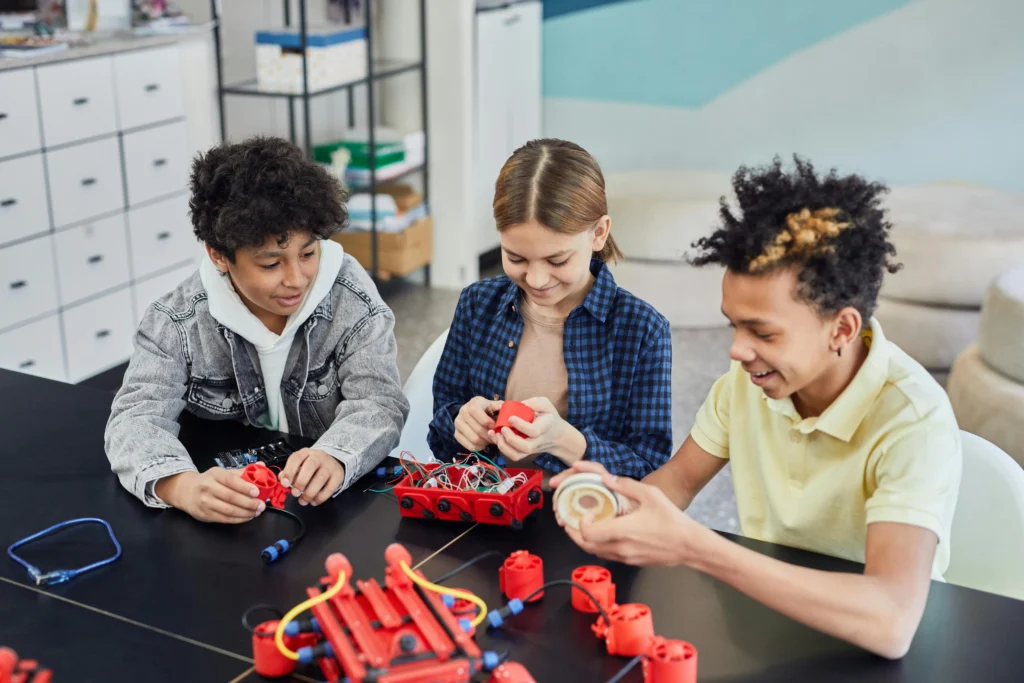
Play takes on collaboration and strategy. Maker spaces, LEGO engineering, or group projects allow children to tinker, design, and problem-solve together. Storytelling becomes collective, with children co-authoring plays, comics, or digital stories. Simulation projects (like running a pretend business or designing a city) weave together maths, literacy, science, and social studies. Cooperative sports and board games refine teamwork, resilience, and the ability to think strategically under pressure.
ages 12-16
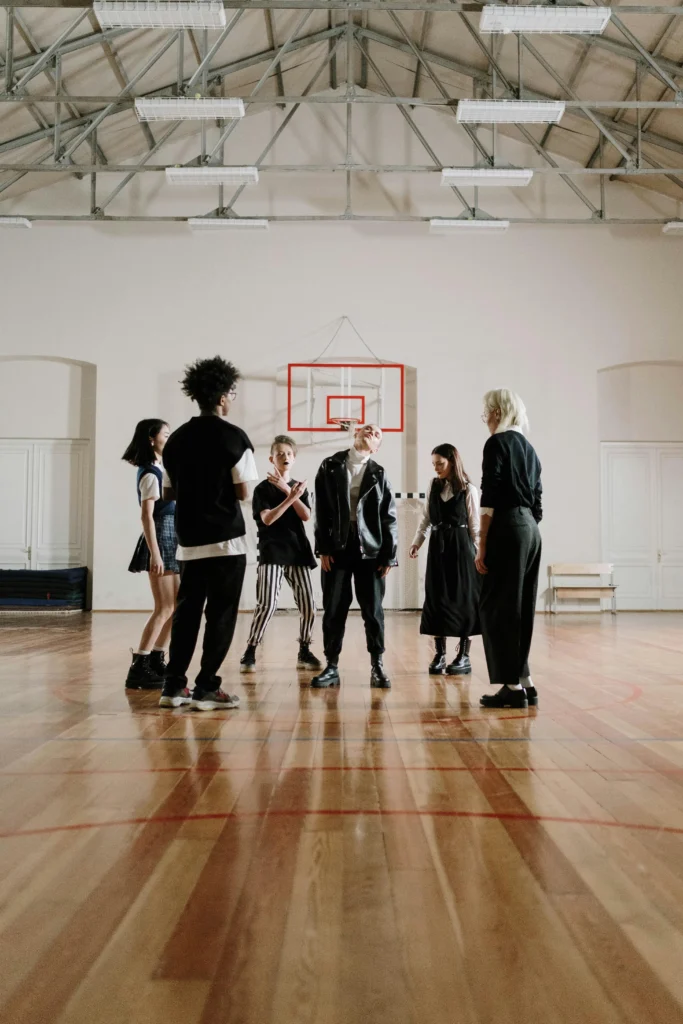
Adolescents channel play into creativity, debate, and real-world problem-solving. Improvisation in drama sharpens confidence and empathy. Digital simulations and creative tech, from coding a game to designing a prototype, turn abstract ideas into hands-on experiments. Debates and role-play in history or science let students’ step into the shoes of past figures or researchers, grappling with complexity in active ways. Problem-based projects challenge students to solve global issues through designing sustainable products, reimagining local spaces, or tackling social dilemmas. All where play becomes the spark for innovation.
Final Thoughts

The evidence and examples shared here show that play doesn’t need to be abandoned with age, it evolves. It adapts with us, keeping alive the curiosity and creativity that fuel all genuine learning. Far from diluting rigour, play strengthens it. Children still wrestle with confusion, frustration, and challenge, but through play they learn to regulate emotions, persist, and grow stronger in the process.
So, what more are we waiting for? What is left to prove? When I have spoken to researchers and educators around the world, there is a hesitation. But as I sit here writing, sipping on my espresso, I think about the rising anxiety, disconnection, and disinterest among students today. So, I can’t help but wonder, if we tried, what’s the worst that could happen.
Until next time, stay curious
Dr Will Zoppellini


References
- Nelson, E. E. 2017. Learning through the ages: How the brain adapts to the social world across development. Cognitive Development.
- Söderqvist, S., Nutley, S.B., Peyrard-Janvid, M., Matsson, H., Humphreys, K., Kere, J. and Klingberg, T. 2012. Dopamine, working memory, and training induced plasticity: implications for developmental research.Developmental psychology, 48(3), p.836.
- Whitebread, D., Coltman, P., Jameson, H. and Lander, R. 2009. Play, cognition and self-regulation: What exactly are children learning when they learn through play?.Educational and Child Psychology, 26(2), p.40
- Johnston, O., Wildy, H. and Shand, J., 2023. Teenagers learn through play too: communicating high expectations through a playful learning approach.The Australian Educational Researcher, 50(3), pp.921-940.
- Immordino-Yang, M., & Damasio, A. 2007. We feel, therefore we learn: The relevance of affective and social neuroscience to education. Mind, Brain, and Education, 1(1), 3-10.
- Jay, J.A. and Knaus, M. 2018. Embedding play-based learning into junior primary (Year 1 and 2) curriculum in WA.Australian Journal of Teacher Education (Online), 43(1), pp.112-126.
- Andreopoulou, P. and Moustakas, L. 2019. Playful Learning and Skills Improvement. Open Journal for Educational Research, 3(1), pp.25-38.
- Hirsh-Pasek, K., Hadani, H.S., Blinkoff, E. and Golinkoff, R.M., 2020. A new path to education reform: playful learning promotes 21st century skills in school and beyond. Policy Brief, pp.1-25.
- Gopnik, A., 2012. Scientific thinking in young children: Theoretical advances, empirical research, and policy implications.Science, 337(6102), pp.1623-1627.
- Pramling Samuelsson, I., & Johansson, E. 2006. Play and learning–inseparable dimensions in preschool practice. Early Child Development and Care, 176(1), 47-65.
- Callanan, M.A., Castañeda, C.L., Luce, M.R. and Martin, J.L., 2017. Family science talk in museums: Predicting children’s engagement from variations in talk and activity.Child development, 88(5), pp.1492-1504.
- Csikszentmihalyi, M. 1975. Beyond boredom and anxiety (1st ed. ed.). San Francisco:
- Jarvis, P., 2009. Play, narrative and learning in education: A biocultural perspective.Educational and Child Psychology, 26(2), pp.66-76.
- Stokes, H. 2019. The worrying decline in children’s playtime: The need for intervention on a nation-wide level.PsyPAG Quarterly goes electronic, 14.