
Play-Based Pedagogy: Unlocking Children’s Potential
5 September, 2025

Author Dr Will Zoppellini
Play, the concept that brings enjoyment, connection, and curiosity to people of any age. It can happen alone, with friends, and even with strangers. It takes place in fantasy, yet it mirrors and reimagines the world around us. For all of us, play is a way to test ideas, learn skills, and even discover parts of ourselves. But for children, the youngest among us, across every culture and community, the impact of play runs especially deep.
A child’s imagination allows them to experiment with the very fabric of the universe. With blocks, they balance the laws of physics. In role play, they invent characters and practise compassion. With crayons, they sketch their view of the world, making sense of what they see and feel. These simple acts not only improve their thinking but also mould the brain itself, advancing dexterity and coordination, and strengthening mind-body connections.
To many adults, it looks like chaos, just a random pile of objects. But this is the purest form of learning. Free experimentation, trial and error, bold inventiveness, all the same qualities that drive our greatest advances in science, art, and engineering.
Table of Contents
Unfortunately, across the globe, play is being steadily reduced in formal educational settings, replaced by rigid instruction and less expressive activities. Once the main event, play has been pushed to the margins. It leaves me wondering when enjoying learning started to be seen as a problem.
Decades of research and case studies from educators worldwide show that play supports growth across multiple areas. These include social and emotional development1, language development2, problem solving3, creativity4, and attitude to learning4. The educational approach that unites these benefits, known as “play-based pedagogy”, is one of the most powerful tools we have, yet it remains under constant threat of being pushed aside.
In this post, we’ll explore what play-based pedagogy is, how it works in practice, and its benefits for literacy, numeracy, and science. We’ll finish with practical strategies you can bring into your own classroom, coaching, or parenting.
So, grab your coffee, and let’s rediscover why play is the most human way to learn.
Understanding Play-Based Pedagogy
Play-based pedagogy is an approach to learning in formal settings, such as preschool or primary education. Many researchers and teachers also refer to it as playful learning14. It’s a way of weaving learning into playful scenarios and activities, so that academic content, skills, and personal growth develop in a way that’s meaningful to children. These playful, child-directed situations are combined with adult guidance and scaffolded learning objectives to allow for progress to be made5.
What sets play-based pedagogy apart from direct instruction is that it is rooted in the very nature of play. Participation is voluntary, child-initiated, and led by curiosity. From this foundation flow two key aspects of learning that shape how children grow.
First, play is pursued for its own sake, not for external rewards6, and this naturally develops intrinsic motivation. In education, it fosters a mindset where learning is valued as an internal process, reducing dependence on constant external validation.
Second, play values the process over the product6. What matters is the act of taking part, not the final outcome. This freedom encourages children to try new strategies without fear of failure. It also nurtures a love of the learning journey itself, helping them prioritise growth and understanding over performance or results (something I explore further in my Growth Mindset blog series).
Another distinctive feature of play-based pedagogy is the role of the teacher, who shifts from being a traditional instructor to becoming a co-player7. This teaching style, often called play-responsive teaching, demands a high level of skill. It requires sharp observation, responsive communication, and the ability to design environments that allow play to thrive8. Children themselves are quick to judge whether something “counts” as play, they look at cues for choice, control, and room for imagination. When these cues are present, they engage more, persist longer, and take creative risks. The teacher’s task is to preserve that sense of playfulness while gently connecting cultural and academic tools such as literacy and numeracy.
Dr Maria Magnusson & Dr Ingrid Pramling Samuelsson8 show the impressive results of play-responsive teaching from their work in Sweden. They studied how teachers could be part of children’s play and support exploration of content areas related to the curriculum. Teachers and children created a “shop,” where lists, labels, money and other factors naturally introduced literacy and numeracy. The teacher didn’t stop play to “teach” reading or writing. Instead, writing lists and recognising numbers became essential for the game to continue. Literacy was not an abstract skill, but a meaningful part of the play world.
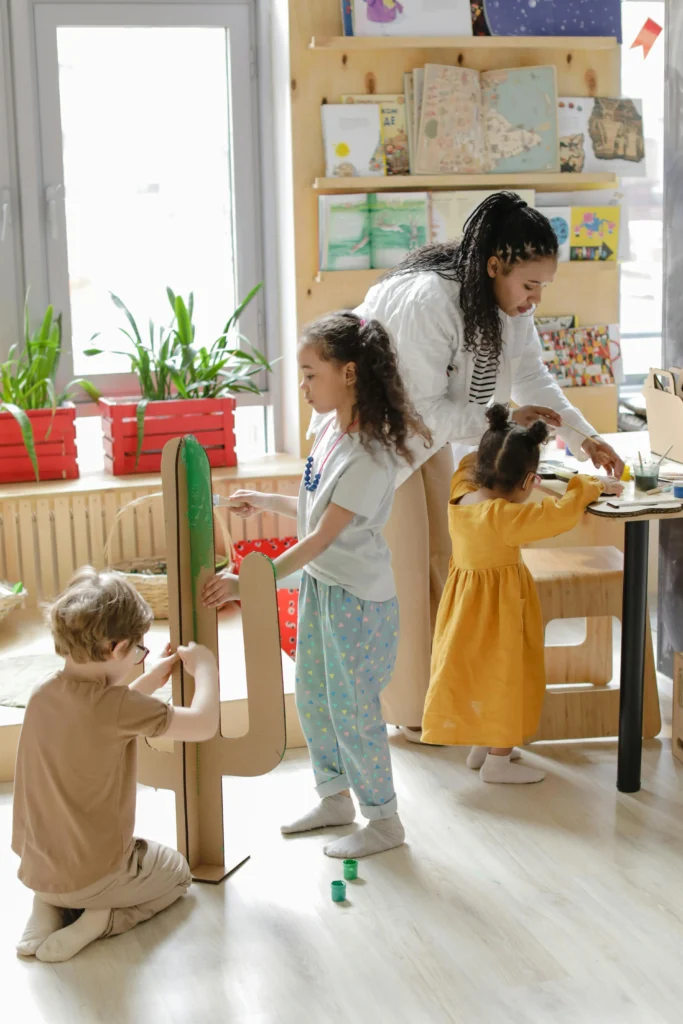
Play-based pedagogy is a careful balancing act. It honours the child’s perspective while deliberately introducing content that stretches understanding, ensuring that learning remains both meaningful and joyful.
Types of Play and the Teacher’s Role
One of the most common misunderstandings I encounter when discussing play is the assumption that it always means free, unstructured activity. Children are left with every resource available, “messing around” rather than choosing purposeful activities. This is not the case. To understand play as a tool for learning, we need to look more closely at the different types of play.
Researchers often describe play as existing on a continuum, stretching from free play at one end to more guided or structured play at the other7. Along this continuum sit varying levels of teacher involvement. Within it, several forms of play offer unique opportunities for learning across the curriculum.
*Flip the tiles to discover some examples:
Symbolic Play
Constructive Play
Play with Rules
These are not strict stages but interwoven forms that children move between across development. What matters is that each type calls for a slightly different teacher role. In symbolic play, the teacher might enrich the storyline by becoming a co-player or introducing new props. In constructive play, the teacher may act more as a mentor, asking questions that stretch design and problem-solving.
This flexibility reflects Vygotsky’s10 idea of the More Knowledgeable Other (MKO): a guide who observes carefully and provides just the right amount of challenge. Play-responsive teaching, in this sense, is not one fixed role but a shifting between a co-player, parallel participant, mentor, or guide. Stepping in with well-timed questions, props, or scaffolding that stretch the child’s skills without taking over11.
Research also shows that children often invite teachers into their play, whether to ask for help with resources, to clarify rules, to gain recognition, or simply to share the fun12. When teachers accept these invitations, play is enriched rather than interrupted. These moments highlight the essence of play-responsive teaching, where teachers use observation, timing, and sensitivity to keep learning both playful and purposeful.
How Play Strengthens Literacy, Numeracy, and Science
One of the greatest advantages of play in learning is its ability to make concepts like literacy, numeracy, and science come alive for children. Play not only makes these fun, it allows them to be introduced earlier and understood more deeply than through traditional approaches. It sounds too good to be true, but a wealth of research supports this. Let’s look at some incredible examples of how guided play, under the right conditions, helps children build meaningful understanding – click to expand the studies below:
Numberland: A Child's World of Math Through Play
A study by Dr Magnusson and Dr Pramling13, followed an adult and a child engaged in dialogue around a drawing the child had created which he called Numberland. This was not just a picture but a playful world in which numbers became countries to be explored.
The learning emerged in the dialogue. The teacher and child shifted continually between the real, everyday world (termed as it is) and the imaginary play world (termed as if). For example, the teacher asked questions such as, “How many countries are there?” helping the child notice and distinguish numerical concepts he had not yet considered. These playful yet probing questions gave the child new cognitive tools for thinking about numbers.
Crucially, the teacher was not instructing from outside but participating from within the play. They co-created the fantasy of Numberland, switching between speaking as part of the story and stepping back to reflect on the play itself (called meta-communicating). This dual involvement allowed the child to explore mathematics in a context that was both joyful and deeply meaningful. An excellent example of play-responsive teaching9.
Discovering Shapes Through Play
Another study comes from Dr Fisher and colleagues14, who explored how children learn the defining properties of geometric shapes. Children were randomly assigned to one of three conditions:
Guided play: The experimenter and child became “detectives” discovering what makes a shape a shape. The adult asked questions, made suggestions, and invited the child to actively explore.
Direct instruction: The experimenter performed the “discovery” while the child observed passively.
Free play: Children explored materials on their own, without guidance.
When later asked to categorise shapes, children in the guided play condition performed best. They correctly identified both standard (e.g., equilateral triangle) and non-standard (e.g., scalene triangle) forms. This demonstrated a deeper conceptual grasp of what defines a shape than children in either the direct instruction or free play groups achieved.
The findings highlight the increased academic outcomes of guided play compared to traditional direct instruction. As well as the advantage of guided play to keep children active and engaged, compared to free play.
It is possible for playful mathematics to be embedded in everyday classroom practices using props, stories, and games to invite children to explore quantities, patterns, and spatial relations15. Literacy, too, is strengthened when play provides a meaningful purpose for writing, reading, and storytelling.
Practical Strategies for Bringing Play into Learning
- Free-choice time - Allow children to choose activities or games, supporting intrinsic motivation. Remember you can still control what resources or materials are on offer if needed.
- Don’t interrupt deep play - When children are absorbed, resist the urge to redirect. Let their concentration grow.
- Follow their lead - If a child suggests an activity, join in or adapt your plan to include their idea. Their agency and choice are vital in this approach.
- Encourage make-believe - Provide props, costumes, and space for role-play. Join occasionally as a character or guide. You can add factors like reading a menu or instructions to help them see reading as part of the game.
- Balance guidance with freedom - Scaffold when needed, but allow children space to explore, test, and fail. It is more important for them to fail and seek guidance than for you to stop them from making the mistake.
Final thoughts

Research, practice, and lived experience confirm again and again that play and learning are two paths woven together. When we treat play as central and understand it’s skilful application, children don’t just absorb information they actively construct understanding, confidence, and a lifelong love of learning.
The evidence is overwhelming. Children who learn through play persist longer, think more creatively, and make connections that formal instruction alone rarely achieves. This isn’t an indulgence, but one of the most evidence-based, developmentally sound practices we have in education.
With this in mind, the question becomes unavoidable – as play enables children to flourish, why would we settle for anything less, stripping away the very conditions that help them thrive?
Until next time, stay curious
Dr Will Zoppellini



References
- Smilansky, S. & Shefatya, L. 1990. Facilitating play: A medium for promoting cognitive, socio-emotional and academic development in young children. Gaithersburg: Psychosocial and Educational Publications.
- Garvey, C. 1991. Play (2nd ed). London: Fontana Press.
- Sylva, K., Bruner, J.S. & Genova, P. 1976. The role of play in the problem-solving of children 3- to 5-years-old. In J.S. Bruner, A. Jolly & K. Sylva (Eds.), Play – it’s role in development and evolution(pp.244–257). Middlesex: Penguin Books Ltd.
- McInnes, K., Howard, J., Miles, G.E. and Crowley, K. 2009. Behavioural differences exhibited by children when practising a task under formal and playful conditions.Educational & Child Psychology, 26(2).
- Weisberg, D. S., Hirsh-Pasek, K., & Golinkoff, R. M. 2013. Guided play: Where curricular goals meet a playful pedagogy. Mind, Brain, and Education, 7, 104-112.
- Gray, P., 2017. What exactly is play, and why is it such a powerful vehicle for learning?. Topics in Language Disorders, 37(3), pp.217-228.
- Pyle, A. and Danniels, E. 2017. A continuum of play-based learning: The role of the teacher in play-based pedagogy and the fear of hijacking play.Early education and development, 28(3), pp.274-289.
- Magnusson, Maria, and Ingrid Pramling Samuelsson. 2019. “Att tillägna sig skriftspråkliga verktyg genom att leka affär.” Forskning om Undervisning & Lärande 1 (7): 23–43.
- Pramling Samuelsson, I. and Björklund, C. 2023. The relation of play and learning empirically studied and conceptualised.International Journal of Early Years Education, 31(2), pp.309-323.
- Vygotsky, L. 1978. Mind and society: The development of higher mental process. Cambridge, MA: Harvard University Press.
- Hedges, Helen, and Maria Cooper. 2018. Relational Play-based Pedagogy: Theorizing a Core Practice in Early Childhood Education. Teachers and Teaching. Theory and Practice 24 (4): 369–383.
- Pramling Samuelsson, Ingrid, and Eva Johansson. 2009. Why do Children Involve Teachers in Their Play and Learning? European Early Child Education Research Journal 17 (1): 77–94.
- Magnusson, Maria, and Niklas Pramling. 2018. “In‘Numberland’: Play-based Pedagogy in Response to Imaginative Numeracy.” International Journal of Early Years Education 26 (1): 24–41. doi:10.1080/09669760.2017.1368369.
- Fisher, K. R., Hirsh-Pasek, K., Newcombe, N., & Golinkoff, R. M. 2013. Taking shape: Supporting preschoolers’ acquisition of geometric knowledge through guided play. Child Development, 84 (6), 1872–1878
- van Oers, B. 2022. The development of mathematical thinking in young children’s play: The role of communicative tools. InTeachin g mathematics as to be meaningful-foregrounding play and children’s perspectives: Results from the POEM5 Conference (pp. 1-12).