

Developing a Growth Mindset: Strategies Around the World
11 July, 2025

Author Dr Will Zoppellini
When research finds its way into schools and education settings, it often arrives stripped of its complexity. Rich, evidence-based ideas are condensed into simplified messages that are easy to share but harder to truly understand or apply.
We’ve all experienced it. You’re given new resources or attend training, you love the messages, it resonates with you as an educator. You sit in a staff meeting with other teachers or coaches, newly energised after a session on growth mindset. Everyone is excited to try something new:
“We’ll tell the kids that mistakes help you learn!”
“We’ll put up ‘Yet’ posters everywhere!”
“We’ll praise their effort!”
Table of Contents
For a few weeks, it seems to work. Students repeat the mantras. You feel equipped with new ways to respond when they struggle, and it feels like you’re making real progress.
But as the weeks go by, something shifts. The enthusiasm wanes. The slogans alone don’t seem to help students embrace challenges or overcome their fear of being “wrong.” Eventually, you hear colleagues muttering, “well this approach doesn’t work”, or “they just can’t do this because they’re so fixed”.
The promise of growth mindset fades, not because the idea is wrong, but because we weren’t shown how to weave it into all the aspects of daily teaching.
In this post, I’m going to share key insights from my own research into growth mindset over the past decade, alongside applied studies in education from around the world, including the U.S., U.K., and Finland. I’ll examine what these studies reveal about creating growth mindset environments, and explore the practical strategies they recommend for making a lasting impact that goes well beyond a few months.
So, pour yourself a coffee, this is the kind of thinking best enjoyed slowly.
Educators Influence on Mindsets
In the early days of growth mindset being studied in school environments, positive results were hard to sustain over long periods of time. Researchers directly delivered the interventions to themselves, succeeding in altering students to endorse a growth mindset than showed many short-term benefits 1.
Sustaining the benefits long term was difficult because there was not sufficient training or information for teachers and the wider school culture 2. Without teachers reinforcing the ideas daily, through language, feedback, and the design of learning tasks, students regressed.
For example, a study in the U.S3 found that students maintained their growth mindset months after an intervention, only when their teachers reinforced it through classroom language and practices. In contrast, another study in the UK4 using a similar intervention, found that without teacher involvement, the positive effects faded over time.
The takeaway is that educators aren’t simply messengers of growth mindset, but architects who build and sustain its culture.
Our Mindset Influences Our Actions & Feedback
Research into growth mindset tells us that believing abilities are malleable can transform how children learn and handle setbacks. But the part that often gets overlooked, is that our mindset as an educator or parent matters just as much as theirs. Our beliefs about children play a huge role how we shape motivation, confidence, and even academic success 1.
A good example of this is given by Aneeta Rattan, Catherine Good, and Carol Dweck, who conducted a series of four studies exploring how instructors respond to students after just one initial assessment of ability at the start of the school year5. What they found was striking:
Instructors with a fixed mindset were more likely to judge students as having low ability based solely on the single test score. This early judgment then shaped how they interacted with those students going forward.
Instead of seeing low scores as a starting point for improvement, instructors with a fixed mindset tended to lower their expectations. They offered comfort to the students rather than challenging them, saying phrases like “It’s okay, math just isn’t your thing.” They also provided less homework, fewer challenging tasks, and less rigorous feedback. In essence, students perceived as low ability were given fewer opportunities to learn and improve.

In contrast, students with high initial scores were treated very differently. Instructors provided them with more demanding activities, higher expectations, and engaging feedback, reinforcing a belief in their capacity to excel.

An educator’s mindset isn’t just a personal belief, it’s a lens through which they view students, interpret performance, and make pedagogical decisions that have real consequences.
Creating a Growth Mindset Pedagogy
Some of the most significant research on developing growth mindset in education has come from a group of researchers in Finland. Dr Inkeri Rissanen, Dr Elina Kuusisto, Dr Kirsi Tirri and their colleagues have been exploring how teachers bring these ideas to life for several years 6,7.
They call it growth mindset pedagogy. Teaching practices that foster a growth mindset in students 8. The researchers have created four core principles teachers can use to cultivate a growth mindset.
four key principles of growth mindset pedagogy
- Avoid quick, stereotypical judgments of students
- Frequent one-on-one interactions
- Learn about individual barriers to learning and help overcome them
- Use differentiation as a foundation of practice
promoting mastery orientation
- Foster learning goals over performance goals
- Emphasise formative assessment
- Avoid comparisons between students
persistance
- Don’t give up on students; reject helplessness
- Don’t protect students from challenges
- Provide honest, critical feedback framed as “not yet”
fostering students’ process-focused thinking
- Praise courage, strategies, and effort
- Teach the positive role of failures, mistakes, and challenges in learning
- Foster incremental beliefs and situational attributions
- Teach learning strategies and emphasize learning-to-learn goals
These principles achieved with “process-focused pedagogical thinking”, seeing learning as a journey, not a judgment of innate ability 8, 9. In addition to the Finnish team, Dr Carol Dweck suggests that designing meaningful and challenging learning tasks is essential for students to develop a growth mindset 10.
Educators should design tasks encouraging risk-taking and problem-solving, where students feel challenged but supported. Students should be encouraged to view setbacks as part of the learning process, and analyse what went wrong, adjust their strategies, and try again.
The focus should be to build resilience and enjoy effort, understanding that even the most accomplished individuals, such as scientists, athletes, artists, or any of their role models have achieved their success through hard work and persistence 10.
Avoiding the Trap of “False Growth Mindset”
Some educators, often unknowingly, fall into what’s known as a false growth mindset, where they believe they are developing growth mindset, but don’t really believe the theory or do not understand all the processes involved 9,11.
To avoid this, educators and parents should take two key steps before applying growth mindset practices:
Understand the full theory
Reflect on your own mindset
In my own research, I found that some teachers misunderstood some key aspects of the theory, not because of neglect, but due to limited training or resources. With a deeper understanding, they could have supported their students more effectively. Often, they wouldn’t get the same benefits as teachers who had a more comprehensive understanding.
The Finnish research team reported similar findings9. While training helped, the most meaningful results came from teachers who genuinely believed in the theory. Their conclusion was that growth mindset must begin with reflection, if necessary, to reshape their own beliefs, otherwise, the approach risks becoming superficial.
Classroom Mindsets in Action:

Let’s look at an example:
It’s towards the end of the school year and Shakiba has experienced regular success in your class. She is outgoing and likes to talk a lot about how much she knows to her classmates. In a run of four weeks, she has very high success with her weekly vocabulary assessment. When she finishes these assessments, she always celebrates in class bragging that she is so smart, because she has scored 100% each week. You set a mock test for the children that should take them 30 minutes to complete. Shakiba completes it in 15 minutes and scores 100%.
Shakiba’s behaviour suggests she’s linking her success to being “smart”. A classic indicator of a fixed mindset. While confidence is great, if Shakiba continues to view easy success as evidence of her innate intelligence, the research shows she may:
- Avoid challenges that could threaten that identity
- Fear failure because it might make her feel "less smart"
- Stop pushing herself to grow when things feel easy
How can you respond
Acknowledge effort and strategies, not traits
Instead of reinforcing the idea that she’s “smart,” highlight the process that led to her success. Draw her learning strategies to the focus of the praise: “It’s clear you’ve been using some great strategies to learn these words. Which ones helped you the most?”
Introduce productive challenges
Finishing tasks early with ease means not enough challenge, encourage her to stretch. “I’m sorry this isn’t challenging enough for you; Let’s see if we can find something that makes you think a bit harder, what do you say?”
You might offer more complex vocabulary, open-ended writing tasks, or peer teaching opportunities to help classmates understand concepts.
Foster process-focused thinking
Help her see learning as ongoing. Reinforce ideas about effort, strategy, and persistence. “I love seeing how you keep building your skills. What’s one thing you’d like to challenge yourself with next?”
Final Thoughts

As a teacher, coach, or parent we have the power to inspire growth, or limit it, through the mindsets we hold and the learning environment we create.
Encouraging a growth mindset in children goes beyond the motivational phrases. It’s about creating systems and a culture that genuinely reflects the belief that every student can learn and thrive.
Until next time, stay curious
Dr Will Zoppellini
Another cup of theory? Discover more...

how to grow your brain: what neuroscience tells us about learning, mistakes, and motivation

Beyond the posters: how schools, education and sports organisations can build environments for growth mindset
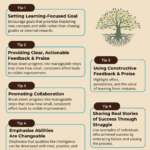
Download the practical strategies from this post as a free printable infographic
*By signing up, you agree to receive emails from Coffee & Theory. You can unsubscribe at any time.

References
- YEAGER, D.S., CARROLL, J.M., BUONTEMPO, J., CIMPIAN, A., WOODY, S., CROSNOE, R., MULLER, C., MURRAY, J., MHATRE, P., KERSTING, N., and HULLEMAN, C. 2022. Teacher mindsets help explain where a growth-mindset intervention does and doesn’t work. Psychological Science, 33(1), pp.18-32.
- YEAGER, D.S., and WALTON, G. 2011. Social-Psychological Interventions in Education: They’re Not Magic. Review of Educational Research, 81(2), 267-301
- SCHMIDT, J.A., SHUMOW, L., KACKAR-CAM, H. 2015. Exploring Teacher Effects for Mindset Intervention Outcomes in Seventh-Grade Science Classes. Middle Grades Research Journal, 10, 17
- DONOHOE, C., TOPPING, K., and HANNAH, E. 2012. The Impact of an online Intervention (Brainology) on the mindset and resiliency of secondary school pupils: a preliminary mixed methods study. Educational Psychology, 32(5), 641-655.
- RATTAN, A., GOOD, C., and DWECK, C.S. 2012. “It’s ok — Not everyone can be good at math”: Instructors with an entity theory comfort and demotivate students. Journal of Experimental Social Psychology, 48(3), 731-737
- RISSANEN, I., KUUSISTO, E., HANHIM KI, E., and TIRRI, K. 2016. Teachers’ implicit meaning systems and their implications for pedagogical thinking and practice: A case study from Finland. Scandinavian Journal of Educational Research
- RISSANEN, I., KUUSISTO, E., HANHIM, E., and TIRRI, K. 2018. The implications of teachers’ implicit theories for moral education: A case study from Finland. Journal of Moral Education, 47:1, 63-77
- RISSANEN, I., KUUSISTO, E., TUOMINEN, M., and TIRRI, K. 2019. In search of a growth mindset pedagogy: A case study of one teacher’s classroom practices in a Finnish elementary school. Teaching and Teacher Education, 77, 204–213
- RISSANEN, I., LAINE, S., PUUSEPP, I., KUUSISTO, E., and TIRRI, K. 2021. Implementing and Evaluating Growth Mindset Pedagogy–A Study of Finnish Elementary School Teachers. In Frontiers in education. p. 385.
- DWECK, C.S. 2010. Even geniuses work hard. Educational Leadership, Sep 1, 16
- DWECK, C.S. 2015. Carol Dweck revisits the “growth mindset”. Education Week, 35, 20, 24.