


Child exploring a glowing interactive learning display with curiosity and focus

Self-Determination Theory: Why Motivation Can’t Be Manufactured

17 April, 2026

Author Dr Will Zoppellini 

A teacher stands at the front of the classroom watching thirty-five students begin a task. Some lean forward immediately, pens moving, eyes scanning the page. Others hesitate. A few start slowly, glancing around to see what everyone else is doing. One student turns the page over and begins doodling in the margin. The instructions were clear. The task was appropriate. The timing made sense. Yet the room divides quietly into engagement and withdrawal.

So, the teacher does what teachers are trained to do. They circulate, encourage, remind, and prompt. “Just give it a go.”“You can do this.” “You need to focus.” A name is written on the board as a warning, then a reward is offered to those who finish, and a countdown begins. The engagement improves, and work begins to appear. But something still feels off. The students are completing the task, yet the room lacks energy. The learning is happening, but it feels shallow, like everyone is completing something without really connecting to it.

We may all have believed that the child’s motivation is the issue, but this is often where our assumptions about motivation quietly mislead us.

Table of Contents

For decades, motivation has been linked to some of the most important outcomes in education. When learners are more motivated, they tend to stay engaged longer, persist through difficulty, organise knowledge more coherently, apply what they have learned more often, and achieve more strongly over time1,2,3. But where that motivation comes from is essential. Attempts to increase motivation in classrooms have often relied on external incentives such as rewards, praise, grades, sanctions, and pressure, all designed to encourage students to engage. These approaches assume that motivation can be generated from the outside, that learners can be nudged, pushed, or pulled toward effort.

Self-determination theory asks us to rethink this common assumption. Motivation is not simply a trait that sits inside a child, waiting to be switched on by praise, prizes, pressure, or discipline. Rather, human beings are born with tendencies toward growth, curiosity, challenge, and development, and those tendencies either flourish or wither depending on the conditions created and sustained around them4.

That matters enormously for teachers, coaches, parents, and educators. If motivation for learning is based on the conditions we create, then our task changes. This week, I want to introduce Self-Determination Theory as a framework way of thinking about motivation for learning, show where education often misunderstands this, and explore the three psychological needs that help motivation become deeper, healthier, and more sustainable.

So find a quiet corner, let the coffee settle, and let’s gently rethink what we really mean by motivation.

Understanding the Quality of Motivation

Student motivation is not a new concern in education. Yet increasingly, teachers report more learners who appear disengaged, reluctant, or unable to sustain motivation across time5. When learners disengage, we often look for the problem inside the child, focusing on their effort or attitude, and encouraging them to try harder, concentrate more, or push through difficulty4. In classrooms, this commonly leads to strategies that include rewards for completion, praising finished work, sanctions for inattention, comparison with peers, or pressure through assessment. These approaches assume that motivation can be increased by applying the right external lever7.

This view risks confusing behaviour with motivation itself. Students may often comply without investing, complete tasks without curiosity, or succeed in a performance without understanding. In these cases, the work is visible, but the learning remains fragile at best. Self-determination theory suggests that motivation is not simply about getting learners to act, but about the reasons that sit beneath their actions. Those reasons shape the quality of engagement, not just the quantity8.

Student sitting at a desk reading and thinking carefully during a classroom task

This distinction becomes clearer when we understand both intrinsic and extrinsic motivation. Intrinsic motivation refers to engaging in an activity because it is inherently interesting or satisfying9. It reflects a sense that learning is worth doing in itself. In contrast, extrinsic motivation refers to engagement driven by outcomes separate from the activity, such as rewards, grades, approval, or avoidance of punishment1. Importantly, self-determination theory does not treat all extrinsic motivation as equal. Some forms are highly controlled, such as working only for rewards or to avoid consequences. However, other forms become more autonomous, such as when learners identify personal value in what they are doing, even if the task itself is not immediately enjoyable. For example, a teenager may not enjoy practising technical drawing skills, but persists because they know it will help them bring their creative ideas to life in art or design.

This shift from intensity to quality is central, because the focus is not simply whether learners are motivated, but how they are motivated. Different forms of motivation lead to different experiences of learning. Controlled motivation may produce short-term compliance, but it often brings anxiety, surface-level engagement, or disengagement once pressure is removed. More autonomous forms of motivation are associated with persistence, curiosity, and deeper learning.

We can see a useful example from a study by a research team in Australia10 who conducted a large meta-analysis that included 344 samples and more than 200,000 students across multiple countries. Their findings showed that intrinsic motivation was strongly associated with student success and well-being, while identified regulation (a more autonomous form of extrinsic motivation) was particularly linked to persistence. Introjected regulation, which is driven by internal pressure such as guilt or ego, was related to persistence but also to higher anxiety. External regulation, based on rewards or punishments, showed little association with performance or persistence and was linked with lower well-being. These findings highlight how the quality of motivation matters more than simply increasing effort.

This is where the contribution of Richard Ryan and Edward Deci through the development of Self-Determination Theory becomes particularly important. They reframed motivation not as something imposed from the outside, but as something that emerges from the interaction between individuals and their environments. Their work positioned human beings as naturally oriented toward growth, learning, and mastery, but dependent on supportive conditions for these tendencies to flourish1,4.

Seen this way, motivation is not something educators engineer, but it is something shaped by experience8. When learners feel ownership, value, and connection to what they are doing, engagement becomes more self-directed. When motivation relies primarily on control, pressure, or reward, engagement becomes more fragile.

Key Terms Explained

Engaging in an activity because it is inherently interesting, enjoyable, or satisfying in itself.

Engaging in an activity to achieve an outcome separate from the activity, such as rewards, grades, or approval.

A more autonomous form of extrinsic motivation where a person engages in an activity because they personally value its importance or usefulness.

Motivation that arises from a sense of choice and personal endorsement, including both intrinsic motivation and valued forms of extrinsic motivation.

A controlled form of motivation where behaviour is driven by internal pressures such as guilt, shame, or the need to maintain self-worth.

The most controlled form of extrinsic motivation, where behaviour is driven by external rewards or the avoidance of punishment.

Self-Determination Theory: The Three Psychological Needs

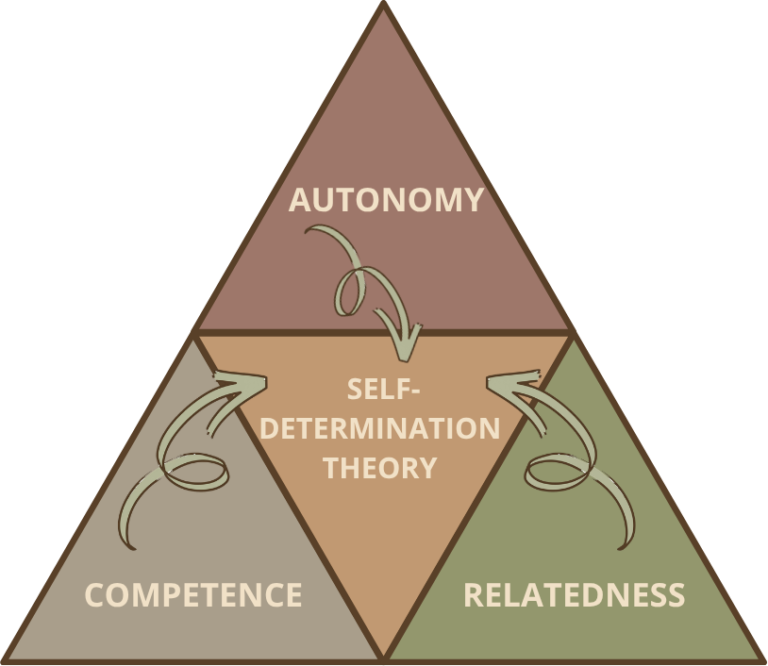
Self-Determination Theory (SDT) has been researched and examined within several contexts that include education, sport, culture, health, disability, environment, and many more. In educational terms, it helps explain why some learners approach learning with high engagement and curiosity while others begin to withdraw, resist, or simply go “through the motions”. At the centre of the theory are three basic psychological needs labelled autonomy, competence, and relatedness1. When these needs are supported, children are more likely to engage, persist, and internalise the value of what they are doing. When they are hindered, motivation becomes more fragile and more controlled11

Diagram showing autonomy, competence, and relatedness as core needs in self-determination theory

Autonomy

Refers to a sense of volition, ownership, and psychological endorsement. Learners feel autonomous when their actions feel meaningful and self-endorsed rather than imposed11. This can be supported by explaining why something matters, acknowledging frustration, offering meaningful choices, inviting initiative, or allowing multiple routes into a task.

Competence

Is the need to feel effective in one’s environment. It is not simply about being “good at school,” but about experiencing challenge as something that can be met. Learners are more likely to remain engaged when tasks are appropriately challenging, expectations are clear, and feedback helps them experience progress. SDT places strong emphasis on the learner’s perception of competence. Children who repeatedly feel ineffective often begin to disengage not because they do not care, but because caring begins to feel too costly11.

Relatedness

Is the need to feel connected, valued, and part of something human. In education, this means more than being physically present alongside others. It means trust, respect, warmth, and the sense that one’s teacher, coach, or parent is not merely managing behaviour but in relationship with the learner. Relatedness matters because human beings internalise values more readily in contexts of security and belonging4.

Importantly, these three needs do not operate in isolation. A child may feel competent but not autonomous, which often produces obedient compliance without a real desire to invest. Another child may feel autonomous but not competent, leading to frustration and avoidance. Another may feel capable and free but emotionally disconnected, which can still lead to withdrawal. Motivation becomes stronger, healthier, and more stable when all three needs are supported together. Research conducted on adolescents in England found that the students who experienced high levels of autonomy, competence, and relatedness showed higher classroom achievement, greater well-being, and lower levels of academic stress and negative emotional experiences12.

The most important takeaway here is that these three psychological needs do not operate in isolation but work interdependently11. Autonomy, competence, and relatedness intertwine to shape how learning is experienced. When we separate them, we risk missing the bigger picture. when we consider them together, we begin to understand how motivation truly takes form.

Motivation Is a Reflection of the Environment

When autonomy, competence, and relatedness are supported together, motivation becomes more robust and sustainable4. A child is more likely to persist, to show curiosity, to tolerate challenge, and to invest in understanding rather than merely focus on an outcome of finishing4. They are also more likely to internalise the value of tasks that are not immediately enjoyable, which is crucial because much of education involves effortful and delayed forms of learning rather than instant interest11. As I write this I do not pretend every task is inherently fun, instead, I am aiming to highlight that even extrinsically motivated learning can become healthier and more self-directed when learners see its value and feel supported in pursuing it. Another benefit is a more meaningful relationship with challenge, failure, and risk taking9.

Student practising piano while teacher provides guidance and feedback

When these needs are frustrated, different patterns emerge. A lack of autonomy often produces compliance on the surface and disengagement underneath, or sometimes open resistance. For example, a student may complete every task set in a lesson, following instructions carefully, yet show little curiosity or initiative, engaging just enough to meet expectations but not enough to truly invest in the learning.

This is a scenario that we would often call “low motivation,” but it may be better understood as the visible expression of an environment that is too controlling, too confusing, too lonely, or too relentlessly evaluative. 

This is also why motivation can fluctuate significantly. The same child may appear engaged in one lesson and shut down in another, not because their character has changed in the space of an hour, but because the psychological conditions have changed. In one room they may feel seen, capable, and involved. In another they may feel controlled, exposed, and unsure of how to succeed. Motivation is not fixed and manually controlled by a child, it is shaped through lived experience of their environment. 

For education, that is both a challenge and an invitation. It means we cannot keep locating motivational “problems” only inside the learner. We have to look at the task, reflect on the relationship, the type of climate, the structure, our feedback, and the goals. We have to ask what kind of experience is being offered to a child each day.

Five Ways to Support Motivation Everyday

Use an invitational rather than controlling approach

Frame tasks as suggestions and guidance rather than commands, helping learners feel a sense of ownership over how they engage.

Take students’ perspectives seriously

Seek and respond to how learners experience the task, building trust and allowing them to feel heard and valued.

Explain the purpose behind learning

Provide clear, meaningful reasons for why tasks matter, supporting learners to internalise value beyond simply completing work.

Build a climate of care and connection

Show consistent warmth, interest, and respect so learners feel safe, supported, and more willing to engage.

Support progress through challenge and feedback

Provide appropriately challenging tasks and give feedback that helps learners see how to improve and move forward.

Final Thoughts

Sketch of a coffee cup with Coffee & Theory logo

If there is one idea here to consider, it is that children do not simply learn because we ask them to, and they do not become motivated because we try harder to make them through rewards and sanctions. Learning is a developmental process shaped by experience, and motivation is part of that process, not separate from it. When we begin to see motivation not as something to manufacture within the child, but as something that emerges from the conditions surrounding them, our perspective shifts. We move away from asking why a child is not trying, and toward asking what it feels like to be that child in that moment of learning.

Perhaps this is where our responsibility as educators, coaches, and parents becomes clearer. We are not just delivering content or managing behaviour but shaping the environments in which children come to understand themselves as learners. The conditions we create influence whether they see learning as something to comply with or something to engage in, whether they avoid challenge or persevere through it, whether they feel disconnected or capable and valued. If we can begin to design experiences that support autonomy, competence, and relatedness, then motivation is no longer something we pursue, but something that emerges, steadily and quietly, from the environments children inhabit.

Until next time, stay curious

Dr Will Zoppellini

Another cup of theory? Discover more...

Child sitting on a stack of books pointing toward glowing math symbols and E=mc², symbolising curiosity, intelligence, and untapped learning potential.

The gifted myth: Rethinking potential in classrooms and playing fields

Two children sitting on the floor drawing mathematical formulas and diagrams on a large chalkboard, illustrating curiosity, learning, and cognitive development.

the changing shape of intelligence: from infancy to Adulthood

Download the practical strategies from this post as a free printable infographic

*By signing up, you agree to receive emails from Coffee & Theory. You can unsubscribe at any time.

cartoon man holding a looking glass pointing at articles, journals

References

  1. Ryan, R. M., & Deci, E. L. 2000. Self-determination theory and the facilitation of intrinsic motivation, social development, and well-being. American Psychologist, 55(1), 68–78.
  2. Reeve, J. 2009. Why teachers adopt a controlling motivating style toward students and how they can become more autonomy supportive. Educational Psychologist, 44(3), 159–175.
  3. Deci, E. L., & Ryan, R. M. 1994. Promoting self-determined education. Scandinavian Journal of Educational Research, 38(1), 3–14.
  4. Ryan, R. M., & Deci, E. L. 2017. Self-determination theory: Basic psychological needs in motivation, development, and wellness. Guilford Press.
  5. K. 2010. Self-determination theory and education: An overview.Institute for Language and Culture, 14, pp.35-58.
  6. Deci, E. L., & Ryan, R. M. 2012. Motivation, personality, and development within embedded social contexts: An overview of self-determination theory. In R. M. Ryan (Ed.), Oxford library of psychology. The Oxford handbook of human motivation (pp. 85–107). Oxford University Press.
  7. Van Lange, P.A., Kruglanski, A.W. and Higgins, E.T. 2012. Theories of social psychology: An introduction.Handbook of theories of social psychology, 1, pp.1-583.
  8. Ryan, R.M. and Deci, E.L. 2020. Intrinsic and extrinsic motivation from a self-determination theory perspective.Contemporary Educational Psychology, 61(1).
  9. HOY, A.W. 2021. Educational psychology. London: Pearson
  10. Howard, J. L., Bureau, J. S., Guay, F., Chong, J. X. Y., & Ryan, R. M. 2021. Student motivation and associated outcomes: A meta-analysis from self-determination theory. Perspectives on Psychological Science, 16(6), 1300–1323.
  11. Niemiec, C. P., & Ryan, R. M. 2009. Autonomy, competence, and relatedness in the classroom: Applying self-determination
  12. Earl, S.R., Taylor, I.M., Meijen, C. and Passfield, L. 2019. Young adolescent psychological need profiles: Associations with classroom achievement and well‐being.Psychology in the Schools56(6), pp.1004-1022.
  13. Guay, F. 2022. Applying self-determination theory to education: Regulations types, psychological needs, and autonomy supporting behaviors.Canadian Journal of School Psychology37(1), pp.75-92.
Scroll to Top

YOUR GUIDE IS READY!

*We’ve also sent the download link to your email.