
Seeing Movement Differently: Applying Variation Theory to Sport, Physical Education, and Dance
24 October, 2025

Author Dr Will Zoppellini
I’ve always been fascinated by how learning begins the moment we notice difference. A note played slightly off key, a stride that feels just a little off balance, these moments awaken awareness. Variation Theory captures that spark of recognition and gives a language to that process. It suggests that learning is an art of attention to what changes, to what stays, and to how those differences give shape to understanding itself. Learning and understanding movement of any kind takes the same process.
Imagine, in a studio somewhere there’s a teenage girl called Mia standing in front of a mirror. As the music begins, Mia traced the phrase she’d practised all week. It was clean, almost careful. Her teacher asked, “Again, but imagine water tugging at your wrists.” Mia repeated the phrase and felt her elbows soften, weight pooling and spilling through her arms. Then, “Now as wind.” The same pathway changed again, the edges sharpened, turns quickened, breath arrived differently. The shape of the dance hadn’t altered, yet it felt entirely transformed.
Later, watching herself in the mirror, Mia realised she hadn’t learned a new dance, but she had learned to see the old one differently. Each small shift in intention revealed something new about flow, weight, timing, and expression. What varied brought awareness to what stayed the same. In that discovery lay something deeper than practice, it was understanding unfolding through contrast.
But this isn’t only a dancer’s lesson. It is what all genuine learning feels like, the moment when a familiar movement, idea, or pattern comes alive again because we finally notice what changes, and what remains.
In physical education, sports coaching and dance studios learning is in motion. In the story of Mia, her experience of water, wind, and weight mirrors how understanding deepens when we encounter contrast. Each new variation allows the essential features of movement to come into focus, like balance, rhythm, control, expression.
In this post, I’ll explore how Variation Theory can reshape how we teach and experience all forms of movement in physical education & sport. We’ll look at why traditional step-by-step approaches often limit learners’ understanding, how to design experiences that help students discern movement in richer ways, and what happens when we allow variation to guide discovery instead of correction.
Grab your coffee, take a breath, and let’s explore what it really means to learn through movement.
Table of Contents
Rethinking Movement Learning: From Correction to Understanding
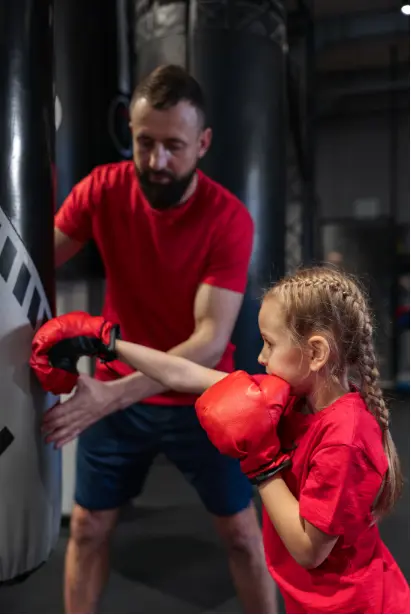
For decades, developing movement and skills in physical education and sport has often followed a linear, step-by-step model1. Learners are shown a technique, they repeat it, and teachers or coaches correct deviations from the “ideal” form. On the surface, this appears as an efficient way to spot errors, make corrections, and improve skills. Yet this approach rests on the assumption that learning movement is simply a process of perfecting a single technique rather than expanding understanding.
In reality, movement learning is more than reproducing a single, decontextualised technique. Each learner comes with different experiences, perceptions, and bodily understandings. While investigating how physical education is taught, colleagues Dr Larsson and Dr Nyberg2 highlighted that, an emphasis on correcting errors can actually limit how students develop their movement capabilities. When the focus is on conformity to a predetermined model, learners are rarely invited to explore what there is to know in moving, and how their body relates to factors such as space, speed, force, and intention.
If we shift perspective and begin with how learners experience movement rather than how they perform it, the purpose of teaching changes3. Instead of asking, “How do I make this technique correct?” we might ask, “What does the learner currently perceive, and what aspects of this movement remain unnoticed?” Scholars investigating learning in classrooms, such as Marton4 and Nuthall5, or in motor learning, such as Magill, all argue that understanding how learners experience the task at hand is the heart of effective teaching. It allows educators to design learning situations that highlight new possibilities for discernment rather than simply correcting visible errors.
This shift from reproducing ideal forms to exploring experiences of movement modifies a fundamental change in how we view knowledge in physical domains. The aim is not to impose the “right” technique but to help learners become aware of the different ways a movement can be experienced, and to support them in discerning which aspects are critical for the goal they are pursuing.
Such an approach places the learner’s perspective at the centre. It also acknowledges that movement knowledge is not purely physical or technical, but that it is experiential. When we treat technique as the endpoint, we close the space for curiosity and interpretation. But when we treat technique as one possible expression within a wider landscape of knowing, we open that space again7. This reorientation, away from replication and towards discernment, lays the foundation for applying Variation Theory to physical education3and sport coaching.
Designing Movement Learning Through Variation
If we view movement learning as understanding rather than imitation, Variation Theory offers a clear framework for how that understanding develops. Rooted in phenomenography, it proposes that learning occurs when people experience difference, specifically in what changes against what stays the same8.
In physical education and coaching, this means students don’t deepen learning by repeating a perfect model but by exploring variations of a skill. Through contrast, they discern what truly matters. A child playing tennis, for example, learns more from feeling the difference between hitting close to the net and from the baseline, or from adjusting grip, stance, and swing path, than from constantly repeating the ‘perfect’ forehand. These contrasts reveal the critical aspects of movement, such as timing, balance, coordination, and control, that define effective performance.
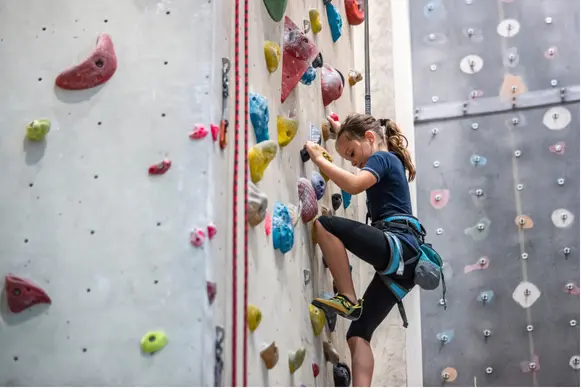
Research shows that experiencing movement in varied ways leads to deeper, transferable understanding9,10. Instead of correcting errors, educators design situations that highlight difference, helping learners notice what they hadn’t seen before. A teacher might vary one element of a task, speed or direction, while keeping others constant. In doing so, they create space for experience and create a new way of seeing the skill. Using experience to construct understanding has also been seen in coaching theories such as games based learning10.
Ultimately, Variation Theory shifts the educator’s role from correcting what is wrong to designing experiences that make the essential aspects or objects of learning visible. It’s not just about doing movement better but seeing it differently.
The Layup You Know Is Only the Beginning
I’ve always believed that theory should feel at home in a gymnasium as much as in a lecture hall. So, let’s step courtside for a moment and think about learning the basketball layup. One of the most recognisable routines in any P.E lesson or coaching session. You’ve probably seen it, done it, or perhaps even coached it yourself.
Let’s take the classic basketball layup drill. Children line up in neat rows along one side of the court. Each player dribbles towards the basket, picks the ball up, takes one step with the right foot, then another with the left, jumps, and pushes the ball against the backboard with the right hand. Then they loop around, join the line on the other side, and repeat the whole thing again, this time mirrored: left foot, right foot, left hand. Step, step, jump, lay it in, again and again.
Eventually, they’re told they’ve learnt the layup. The movement has rhythm, precision, and consistency. But when the whistle blows and the game begins, that certainty starts to crumble. A defender cuts across, the approach angle changes, or the player catches the ball too close to the rim. Suddenly, what was automatic feels impossible. I’ve seen young children freeze mid-game, unsure of what to do because their position to the basket doesn’t match the one from the drill. On more than one occasion I have even seen older children catch the ball directly under the hoop yet instinctively dribble backwards just to recreate the familiar two-step pattern before shooting.
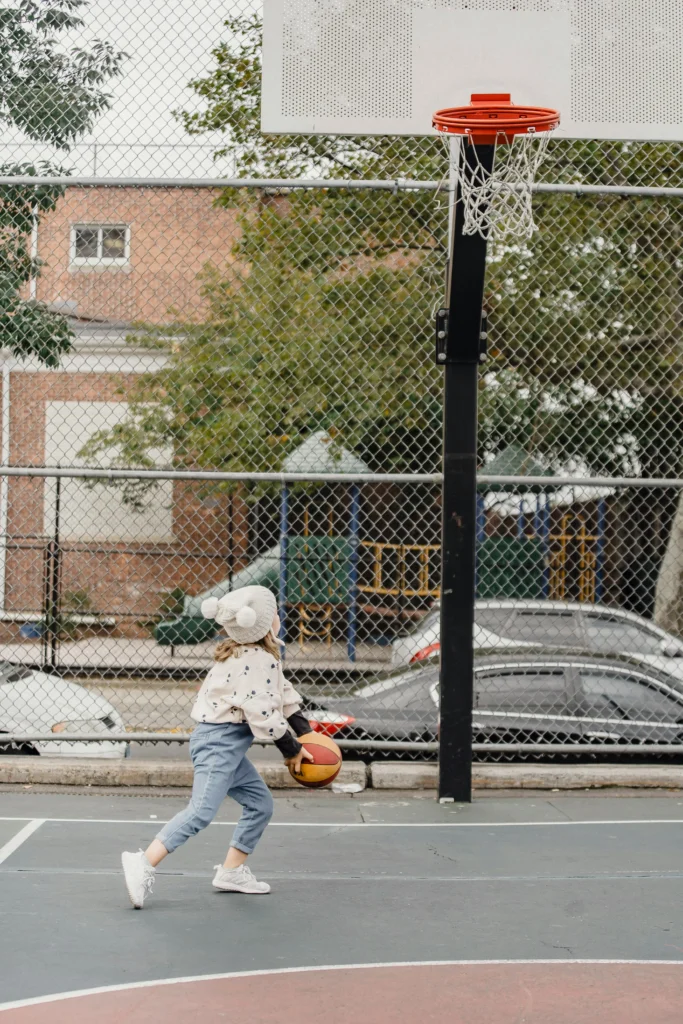
In truth, they’ve learnt one version of a layup, a single way of seeing what the movement can be. But basketball, like all forms of movement, is filled with variation. Sometimes a layup is rolled softly off the fingertips because a defender is on your shoulder. Sometimes it’s reversed, sometimes taken without the backboard, sometimes jumped off the opposite leg because of how the pass arrived. For an exhaustive visual example, you need only type “Michael Jordan layups” or “Kyrie Irving layups” into YouTube for a moving gallery of how many ways there are to understand one skill.
In the language of Variation Theory, the player who only knows the layup as “two steps and a shot off the glass” has discerned only part of its critical aspects. The necessary conditions, balance, angle, timing, and control, remain hidden beneath the uniformity of repetition. Real learning begins when those variations are deliberately surfaced, when the learner experiences what can change and what must stay the same.
Five Ways to Apply Variation Theory in Physical Education and Coaching
*flip the tiles to discover more
Bring attention to the object of learning
Begin from learners’ experience
Vary one thing at a time
Use example, contrast, and non-example
Design for discovery, not correction
Final Thoughts

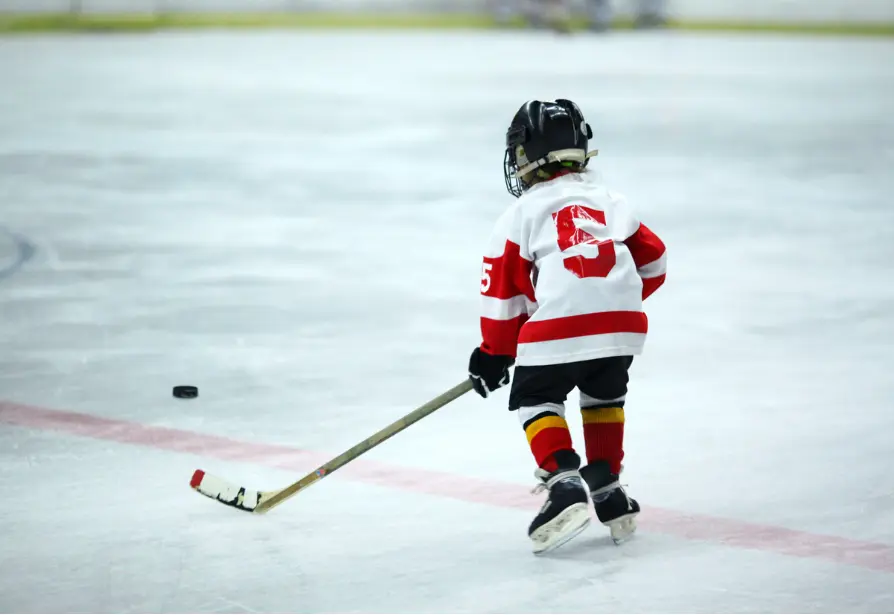
In movement, as in every form of learning, understanding comes alive when difference is experienced, not just explained. Variation Theory reminds us that teaching is less about transmitting the “right” technique and more about designing environments where learners can see, feel, and reflect on experiences. With that awareness, critical thinking and creative problem-solving on the court, stage, field, or pitch follow naturally. A child who can discern angle, timing, and balance in finishing will invent layups you never taught. A hockey player who can sense the difference between control and release will find new ways to move through defenders with rhythm and precision.
More than this, it invites fun and exploration into how someone moves and gives each learner the agency to discover more. Joy and engagement improve as they find ways that work, rather than being told what to do. In the end, learning through variation is all about movement as curiosity, understanding as discovery, and coaching as the art of helping others see differently.
Until next time, stay curious
Dr Will Zoppellini



References
- Launder, A. and Piltz, W., 2013.Play practice: The games approach to teaching and coaching sports. Human Kinetics.
- Larsson, H., & Nyberg, G. 2016. It doesn’t matter how they move really, as long as they move.” Physical education teachers on developing their students’ movement capabilities. Physical Education and Sport Pedagogy, 22(2), 137–149.
- Nyberg, G. 2023. What it means to be a learner and what it means to learn and know in movement skill learning.Quest, 75(2), pp.119-135
- Marton, F., & Booth, S. 1997. Learning and awareness. Lawrence Erlbaum Associates.
- Nuthall, G. 2004. Relating teaching to classroom learning: A critical analysis of why research has failed to bridge the theory-practice gap. Harvard Educational Review, 74(3), 273–306.
- Magill, R. A. 2011. Motor learning and control: Concepts and applications. McGraw-Hill.
- Marton, F. 1995. Cognosco ergo sum. Reflections on reflections. Nordisk Pedagogik [Nordic Pedagogy], 15(3), 165–175.
- Marton, F., & Pang, M. F. 2006. On some necessary conditions of learning. Learners must discern the object of learning’s critical aspects through experiencing variation against invariance.
- Nyberg, G., & Larsson, H. 2017. Physical education teachers’ content knowledge of movement capability. Journal of Teaching in Physical Education, 36(1), 61–69.
- Light, R., 2012.Game sense: Pedagogy for performance, participation and enjoyment. Routledge.