
The Art of Noticing: How Play and Variation Theory Shape Meaningful Learning
21 November, 2025

Author Dr Will Zoppellini
The construction corner had erupted into quiet chaos. Wooden blocks were stacked into towers that leaned like tired trees. Three children crouched on the carpet debating which tower counted as the tallest. One child placed a single block sideways on top and insisted that this made it the champion. Another child disagreed and announced that the tower now looked wrong and had to be rebuilt from the bottom.
A teacher settled beside them and listened to the discussion with gentle attention. After a moment she asked, “What makes a tower the tallest in your city and what makes it just a pile of blocks”. The room paused for a heartbeat. The play continued. And something new began to open.
The question did not end the game. It opened it. The children stayed inside their imaginary world, yet they began to look at it in a slightly different way.
Moments like this shaped the reason I began this blog. I want to bring research closer to the people who guide children every day. Teachers, parents, coaches and educators often hold rich experience, yet the theories behind that experience can feel distant. One of my goals is to show how different approaches to learning can complement each other. They do not need to sit in opposition.
This post brings together two strands I have been exploring recently. Play based learning and variation theory. Play offers the open, flexible, high potential space where children explore. Variation Theory gives us a lens that helps shape what becomes visible within that space. It helps reveal the concepts, distinctions and structures we want children to notice.
In this post I explore why play creates a powerful learning environment, what variation theory adds, how the two work together in practice, and practical tips you can use straight away.
Grab your coffee, find some head space, and join me in exploring how these ideas meet and deepen understanding.
Table of Contents
Understanding Learning Inside the World of Children’s Play
If you ask children what they enjoy most, they’ll probably say play1. From their perspective, play and learning are not kept in separate categories. Both are present when they mix mud pies, negotiate rules, build dens or explore picture books. For an educator, this is freeing, because learning doesn’t always need to begin with a planned activity. It is already happening inside the play, and the adult can step into what is unfolding and gently guide attention toward new meaning2.
Play scholar Brian Sutton Smith3 described play as a form of developmental high potentiality. A central reason for this is because during early childhood, the brain creates more neural connections than it will eventually keep. Flexibility in creating pathways arrives before precision is needed. Play reflects this natural process. Children can try an idea, reverse it, stretch it, shrink it or discard it entirely. They can explore without the weight of consequence. A playful environment protects a wider range of possible actions and ideas than a tightly controlled task often allows.
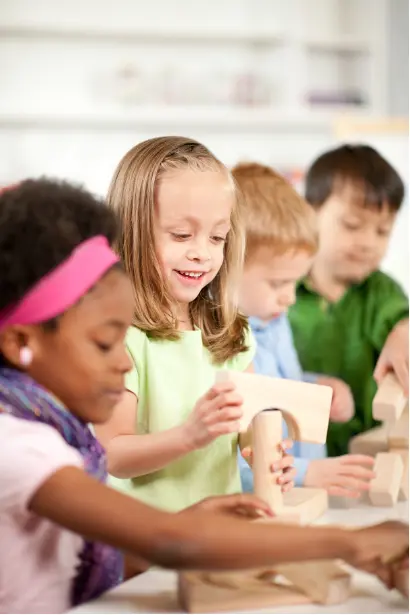
From this position the central question for us is not whether children are learning during play. Instead, the question becomes what they are learning and whether the adult helps them notice the intended concepts4.
This is where several authors4,5 in variation theory offer a helpful distinction between what they term, ‘act‘ and ‘object‘. The act is what children are visibly doing. The object is what they are learning about. Children playing shops might seem to be acting out roles, yet the object might be number, exchange, fairness or social rules. If an adult stops at the surface impression that the children are just playing shops, an opportunity is missed. The deeper question is “What concept could this play be about? What might they already be trying to understand?”
This partnership between play-based learning and variation theory rests on a simple idea. The adult begins from the child’s perspective and then connects the child’s meaning making to a learning object without draining the life from the play. Play provides the canvas. Variation theory helps the child notice the picture that is emerging.
How Variation Theory Deepens What Children See in Play
Variation theory emerges from Ference Marton’s concept named Phenomenography4,6, which begins with the observation that although people share the same world, they experience it in different ways. A puddle might be a mirror, a splash zone, or a measuring station, depending on the child. Learning, from this perspective, involves gaining new ways of seeing the same phenomenon or concept to understand it’s whole structure.
At the centre of variation theory is the object of learning6. This is the specific understanding an educator wants the child to develop. Each learning object contains critical aspects, the features a child must notice in order to grasp the object with depth7. For a triangle this includes three sides and three angles. For the mathematical notion of “half “ it is the understanding that each part must contain an equal number or quantity. If these aspects remain hidden, the concept stays shallow even when a child can name it confidently.
Variation theory proposes that children notice critical aspects when they experience systematic variation and contrast8. To understand flower, for instance, a child benefits from seeing daisies, roses and tulips rather than only one example. They also benefit from seeing how flowers differ from other plants. Through these experiences the child begins to notice what belongs to the concept and what does not.
For educators working in play-based settings this creates powerful opportunities. The role of the adult becomes one of tuning into the child’s perspective and then shaping what becomes visible. This can be done by adjusting materials, adding contrast, rearranging the environment or asking questions that highlight the differences that matter. Research supports this idea. For example, Svensson9 found that when preschool teachers used variation theory to guide children’s spontaneous play, the children began to show deeper mathematical understanding, particularly abstract thinking. Variation theory helps transform play into a space where conceptual growth becomes more noticeable and more intentional.
Variation theory also encourages the educator to reflect on the relationship between intention and experience. An adult has an intended object of learning, the idea they hope the child will understand. This must be enacted, meaning the play must contain opportunities for the child to experience the critical aspects in a clear and accessible way. The lived object of learning is what the child actually takes from the play. When an educator pays attention to these three layers, the intended learning becomes far more likely to appear within the play and far more likely to be understood by the child.
Examples of Variation Theory at Work Inside Children’s Play
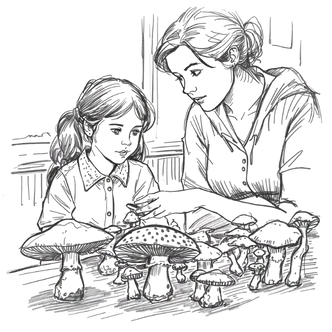
To see how these ideas come together, let’s examine an example from one study1 in early childhood: A group explored mushrooms outdoors. A five-year-old announced that toadstools were poisonous. The teacher, thinking about the learning objective of symbols, asked, “How could you help other children know that this mushroom is poisonous”
The girl suggested writing a note.
“Can young children read” the teacher asked gently.
The child paused, picked up a pencil and drew a mushroom with a clear cross through it.
The teacher then added further variation. “Are there other ways of finding out which mushrooms are poisonous or edible”
The child mentioned a book her mother had at home.
“And more ways” the teacher continued.
The child reflected and said, “If you learn to recognise the tasty mushrooms instead, you focus on finding them and you will not see the poisonous ones”
This is variation theory inside play. The teacher did not change the activity. She changed the noticing. Through contrast, prompting and perspective taking she helped the child see new aspects of classification, representation and investigation. The play remained intact. The learning deepened.
To broaden the picture, consider another example from a study10 of four- and five-year-olds exploring the mathematical notion of “half”: At the start many children saw half as simply cutting something into two. Half a banana. Half a biscuit. The teacher introduced a clear contrast between equal and unequal parts. She used objects that could be grouped and counted. Instead of slicing food and saying that is half, the children compared sets and asked, “Are these halves” and “Do they have equally many”, “What if one set has three and the other five.”
By changing the number and grouping of objects through variation, while keeping the idea of half constant, the children began to understand that half is a numerical relation and not just a cutting action.
Across these examples the pattern stays consistent. Play provides openness. Variation creates structured noticing. The adult guides attention with sensitivity. Combined they create conditions for conceptual growth.
How to Guide Learning Through Play With Variation Theory
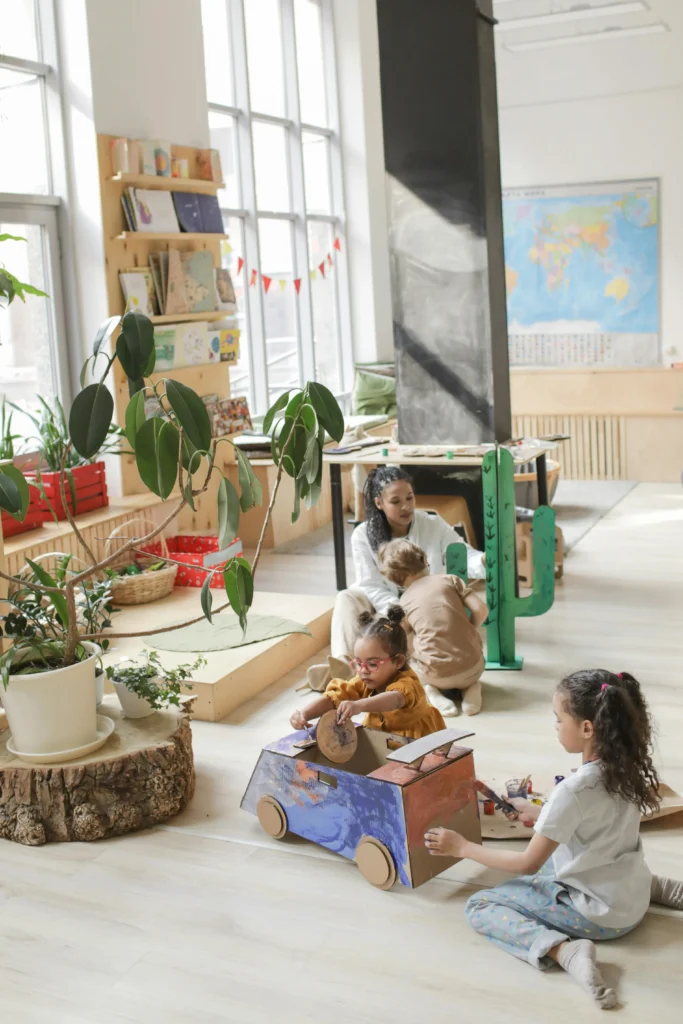
Working with play and variation theory means the educator understands the science that underpins both ideas while approaching the daily practice as an art. This blend is one of the things I value most about the role of any educator, whether that is a teacher, sports coach or parent. You combine science and art to create an exploratory environment. In practical terms this means respecting children’s ideas without losing the integrity of the learning object.
One of the mathematical studies11 in a series I have already discussed, captures this balance perfectly: A group were exploring the notion of “half”. During the activity a child suggested bringing in extra props. The props would have changed the set of materials the teacher had chosen to highlight the numerical meaning. The teacher faced a familiar dilemma. Should the child’s creativity guide the next step or should the focus stay with the intended object of learning. On this occasion the teacher validated the idea by saying “That’s interesting; we can try that another time”, while keeping the attention on equal sets. Later the child’s idea became the starting point for a new activity. This is the artistry of teaching in play. The educator protects the learning while still honouring the child’s agency in being creative.
To get started with your children, here are a few quick tips you can think about and try:
*Flip the tiles to discover some examples:
Start from the child’s perspective, then refine the object.
Make The Invisible Visible.
Vary one element at a time.
Use children’s ideas as natural variation.
Ask meta questions.
Check alignment afterward.
Final Thoughts

Educators often stand between two landscapes. One is full of movement and imagination, shaped by the open energy of children’s play. The other carries the weight of concepts, intentions and the quiet discipline of teaching for understanding. It can feel as though these landscapes compete for attention, yet they meet far more naturally than they appear.
Play gives children a world they can shape with their own hands and ideas. Variation theory gives the adult a way to reveal the relationships inside that world. Together they create a space where curiosity can meet understanding. A simple question can guide attention toward meaning.
When an educator embraces this blend, learning becomes something deeper than a task or a worksheet. It becomes a way of seeing. A way of noticing. A way of understanding the world through the very language children speak most fluently, their play.
Until next time, stay curious
Dr Will Zoppellini



References
- Samuelsson, I.P. and Carlsson, M.A. 2008. The playing learning child: Towards a pedagogy of early childhood.Scandinavian journal of educational research, 52(6), pp.623-641.
- Pyle, A. and Danniels, E. 2017. A continuum of play-based learning: The role of the teacher in play-based pedagogy and the fear of hijacking play.Early education and development, 28(3), pp.274-289.
- Sutton Smith, B. 1997. The ambiguity of play. Cambridge, MA: Harvard University Press.
- Marton, F. and Booth, S. 2013.Learning and awareness. Routledge.
- Pramling Samuelsson, I. 2006. Teaching and learning in preschool and the first years of elementary school in Sweden. Nordic childhoods and early education: Philosophy, research, policy, and practice in Denmark, Finland, Iceland, Norway, and Sweden, pp.101-131
- Marton, F., 2014.Necessary conditions of learning. Routledge.
- Marton, F. and Pang, M.F. 2006. On some necessary conditions of learning.The Journal of the Learning sciences, 15(2), pp.193-220.
- Pang, M.F. and Ki, W.W. 2016. Revisiting the idea of “critical aspects”.Scandinavian Journal of Educational Research, 60(3), pp.323-336.
- Svensson, C. 2022. Discerning preschool teacher’s experiences to enhance children’s participation in mathematical play activities.SN Social Sciences, 2(8), p.157.
- Bjorklund, C. 2018. Learning about” Half”: Critical Aspects and Pedagogical Strategies in Designed Preschool Activities.Scandinavian Journal of Educational Research, 62(2), pp.245-263.
- Björklund, C. 2016. Challenges and virtues of theory-driven education–A meta-study of variation theory implemented in early childhood mathematics education.Education Inquiry, 7(4), p.28773.