
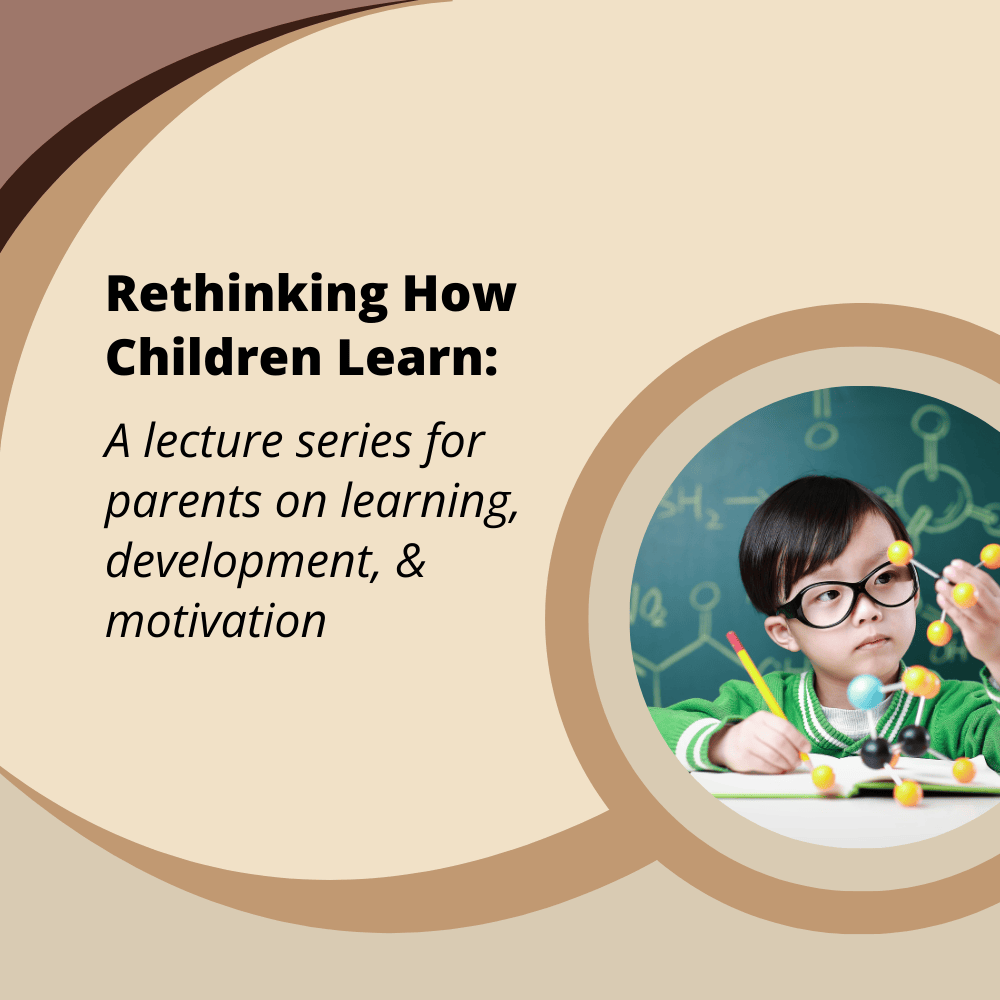
Coffee & Theory Lecture Series: Rethinking how children Learn
Series Overview
If you’ve ever wondered why learning seems easy one week and impossible the next, why motivation comes and goes, or why your child responds so differently to challenge over time, this series is designed for you.
This series of four lectures invites you to step back and rethink how children learn. It brings together research from neuroscience, developmental and educational psychology, behavioural science, and educational theory to help you understand what sits beneath your child’s everyday learning experiences. You’ll explore how learning develops over time, from early childhood through middle childhood and into adolescence.
Across the series, we unpack how the brain develops, how children make sense of new information, and why learning is deeply influenced by context, challenge, and agency. We take time to challenge some of the common myths about learning, as well as explore familiar patterns such as fluctuating motivation, uneven progress, resistance to effort, and changes in confidence. Rather than simplifying these experiences, the series aims to make sense of their complexity.
The focus is not on telling you what to do, but on helping you see learning differently and make sense of what you are already seeing in your child’s learning experiences. By interpreting learning situations more accurately, you can feel more confident supporting your child without feeling responsible for controlling outcomes. The series is designed to support you in creating conditions that allow learning to develop, while protecting your child’s growing independence.
The four lectures
Lecture 1: What Learning Is (and What It Is Not)

What Learning Is (and What It Is Not)
Moving beyond performance, grades, and behaviour
This lecture explores what learning actually means, drawing on research about how the brain develops and how children think, process information, and respond to challenge. We look at learning as a process of change over time, rather than something that can be judged through grades, behaviour, or visible confidence in the moment.
The lecture also examines some of the common myths about how learning is measured, including why struggle, anxiety, or uncertainty are often misread as signs of difficulty rather than indicators of learning in progress. The aim is to offer a clearer way of interpreting what you see, so learning feels less confusing and less tied to constant evaluation.
Lecture 2: How Learning Changes Over Time

How Learning Changes Over Time
Development, difference, and why progress is rarely linear
Learning does not follow a straight line, and children do not learn in the same way at every age. This lecture focuses on how learning develops across childhood and adolescence, and why uneven progress, regression, and sudden shifts are a normal part of development.
We explore how brain development, physical growth, and experience interact over time, and why comparisons between children, or between different stages of the same child, are often misleading. This lecture is designed to help you make sense of change and difference with greater confidence, without rushing to label, worry, or intervene too quickly.
Lecture 3: Motivation, Achievement, and Agency

Motivation, Achievement, and Agency
Why wanting to learn cannot be engineered
Why does motivation seem to come and go? Why do some children resist effort, even when they care? This lecture looks at how motivation develops, and why it cannot be created through pressure, rewards, or encouragement alone.
Drawing on research into motivation and agency, we explore the role of meaningful challenge, achievement, and choice in learning. The lecture helps make sense of why effort only becomes productive when children experience a sense of ownership over their learning and why attempts to “make” children motivated often have the opposite effect.
Lecture 4: Parents as Facilitators
Parents as Facilitators
Creating conditions for independent learning
The final lecture brings the series together by focusing on the role you play in learning, not as instructors or managers, but as facilitators. Rather than offering a set checklist, this lecture explores how you may influence learning indirectly through the conditions you create.
We look at how support, boundaries, and independence interact, and how to step back or step in at the right moments. The emphasis is on supporting learning while protecting your child’s growing independence, confidence, and sense of agency.
Who this series is for
This series is designed for parents of children at any age who want to better understand how children learn. It may be a good fit for you if:
- You want a deeper understanding of how children learn.
- You are interested in research and theories of child learning and want them explained in an accessible way.
- You want to be better equipped to spot myths and interpret advice or information you encounter online.
- You find learning advice confusing, contradictory, or overwhelming
- You want to support your child without feeling responsible for controlling outcomes
- You enjoy thinking, reflection, and evidence-informed discussion
- No prior knowledge in education, psychology, or neuroscience is required, just curiosity and an open mind.
Educators, sports coaches, teachers, tutors, and others with an interest in learning are very welcome to attend. However, this series is designed specifically with parents in mind. For further talks, resources, and products tailored directly to educators and coaches please see the courses & workshops page.
What this series is - and what it isn’t
This is not a parenting course
It is not a prescribed checklist of things to do at home, and it does not offer quick fixes or guidelines for how you should parent.
Instead, it is a research-informed discussion of how children learn, designed to help parents better understand learning, development, motivation, and independence. The focus is on understanding and interpretation rather than judgement or instruction. No qualifications or prior knowledge are required, as the aim is to make the science of learning accessible, meaningful, and open to anyone who is curious about how children learn. All are welcome.

Register to Access the Lecture Series.
After signing up, please check your inbox for the access email. If it doesn’t appear, it may have been filtered into your junk or spam folder. You may find it helpful to add my email address to your contacts or mark it as a trusted sender to ensure future emails are delivered correctly.
FAQ:
Is this a parenting course?
No. This series is not a parenting course, or a checklist of what you should be doing. It does not offer quick fixes.
Instead, it is a research-informed discussion of how children learn, designed to give you a deeper understanding of learning, development, motivation, and independence. The focus is on understanding, interpretation, and perspective, and not instruction or judgement.
Do I need any background in education, psychology, or neuroscience?
Not at all. No qualifications, background knowledge, or prior study are required.
The lectures are pitched at a university level, but the intention is to make the science of learning accessible, meaningful, and understandable for everyone.
How long is each session?
Each session is 45 minutes in total.
Is this suitable for parents of children of different ages?
Yes. The series explores learning across development, from early childhood through middle childhood and into adolescence.
Parents of children at different ages often find different parts of the series resonate more strongly.
How much does the series cost?
This series is FREE.